Search This Blog

Sunday, March 17, 2019

Here Comes The Sun


Go find it.
It's out there.
The promise of Spring.

It's in the breeze that fails to generate a negative wind chill.
It's in the glowing hint of a sunrise on a bike ride to work.

It's in the patch of gravel peeking from a crusted bed of ice.
It's in the prairie grass poking through a snow drift in the ditch.

It's in the ragged, shedding coat of a majestic American bison.
It's in the plaintive bark of a prairie dog seeking cover in a snowy field.
It's in the joyous chirp of a Western Meadowlark perched on a wooden fence post.

It's in the pounce of a puppy at a park astonished with the big world outside.
It's in the anticipation of a family cruising the bike path for the opening of Armadillo's.

It's in the knowing smile of a cyclist pushing a too-tall gear just to feel a little speed again.
It's in the giddiness of a gravel grinder busting out to explore a maybe-rideable remote road.

The promise of Spring.
It's out there.
Go find it.


For a little musical mojo, here's the unofficial anthem of Spring for the past 50 years:  Here Comes The Sun, by singer/song writer George Harrison (Beatles, Abbey Road, 1969). This song just sounds like a Spring sunrise.


Here Comes The Sun (lyrics)
Here comes the sun, here comes the sun,
And I say it's all right
Little darling, it's been a long cold lonely winter
Little darling, it feels like years since it's been here
Here comes the sun, here comes the sun
And I say it's all right
Little darling, the smiles returning to the faces
Little darling, it seems like years since it's been here
Here comes the sun, here comes the sun
And I say it's all right
Sun, sun, sun, here it comes
Little darling, I feel that ice is slowly melting
Little darling, it seems like years since it's been clear
Here comes the sun, here comes the sun,
And I say it's all right
It's all right

Sunday, March 10, 2019

Black Hills Gravel Series - Season 3!

A treasure trove. Right here in my backyard.

The Black Hills Gravel Series returns on April 6, April 13, April 27 and May 4. Mark your calendars.

If you live around the Black Hills and fail to ride these, you are missing something special. If you live outside the Black Hills and fail to drive out for at least one of these, you are missing something special. This is grass roots gravel at its finest.

Director Lucas Haan welcomes folks gathering at the start of the Hill City edition of the 2018 Black Hills Gravel Series.
On that day, over 100 cyclists of all abilities and ambitions enjoyed exploring the surrounding gravel and dirt roads.

Lucas Haan, our local Pied Piper of Cycling, recently announced the BH Gravel Series schedule on the FaceBook group page for the Black Hills Drop Bar, Dirt and Cyclocross Riders. 2019 Black Hills Gravel Series. Similar to last year, the BH Gravel Series features a gathering on four separate Saturdays, each offering a Starter (10 mile), Social (25 mile) and Scenic (50+ mile) route. Lucas hand crafts each of the unique, creative routes through picturesque back country, provides cue sheets for self-navigating the unmarked roads and offers the enriching experience of riding self-supported. All of this free of entry fees, elitism and pomposity. Just ride. 

To join the fun, one merely shows up at the start/finish restaurant, signs a waiver, receives a set of cue sheets, and rides a remote, rough road ride in the amazing Black Hills of South Dakota. If you choose, hang out afterward for lunch with old and new friends. Lucas generally posts updated information on the FaceBook group page noted above, but if you sign up in advance, he will send you timely e-mails. Lucas does all the work. You just ride.

Lucas Haan out on the course checking on riders at the 2018 Black Hills Gravel Series.
These rides truly have something for everyone. In a stroke of egalitarian genius, Lucas added the Starter (10 mile) option last year, which attracted many folks not typically present at local cycling events and totaled about 15% of all riders. At the Hill City event, I met one mom who brought her middle school aged son and three of his friends, all finishing with big smiles and high fives. Another gravel newcomer spoke of his concern of venturing on these backroads with nothing more than cue sheets, but completed the ride without issue, other than wishing it were longer. Yet another gushed that it was more satisfying than riding to Armadillo's for ice cream.

The Social (25 mile) route drew about 50% of the riders and was perhaps the most diverse group of all. I can't help but think that a tempting attraction for many was a sweet 2-3 hour ride starting at a relaxed 9:30 am and finishing with lunch at a microbrewery. Those folks certainly had a good time.

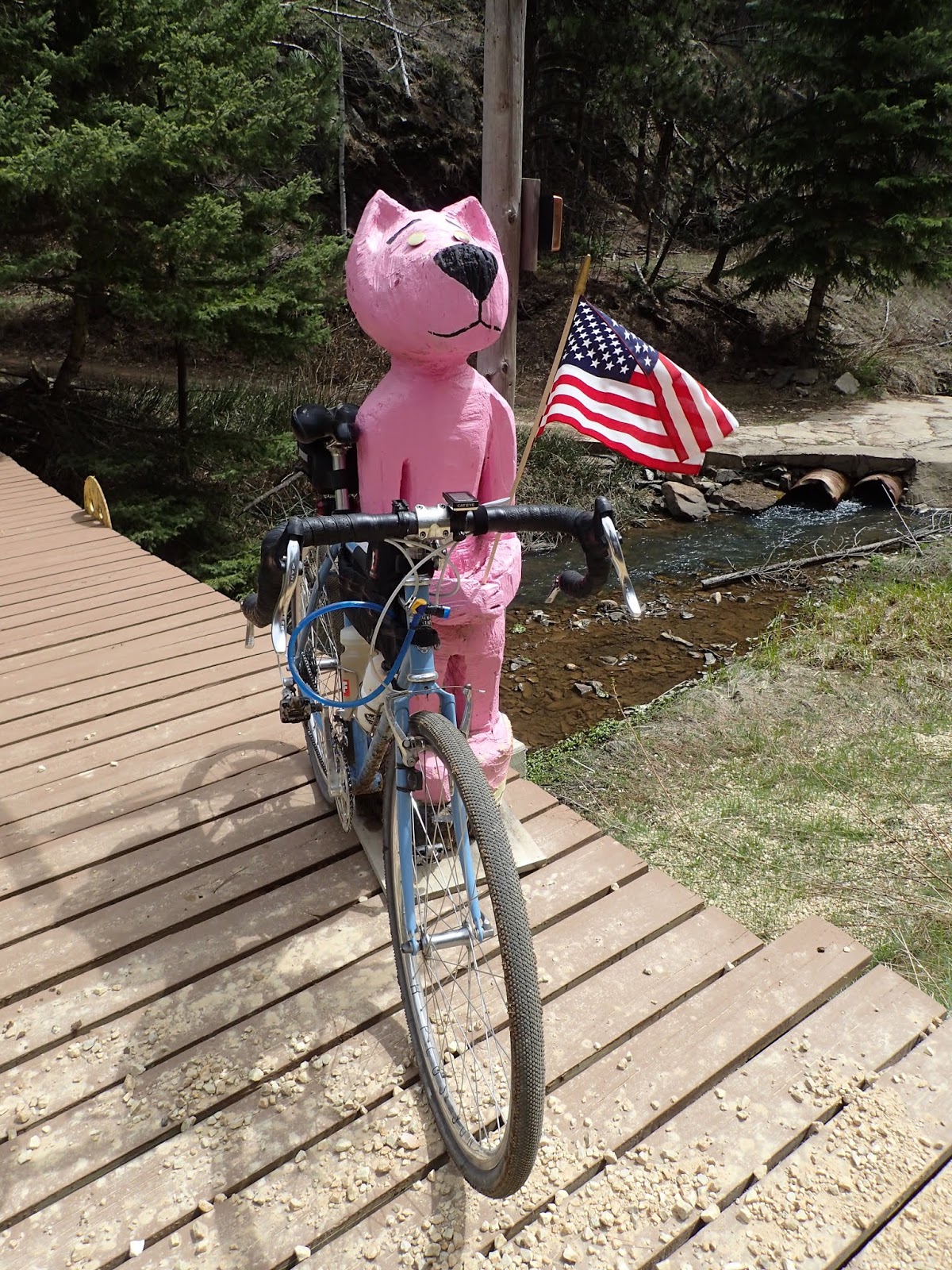
The remaining 35% rode the Scenic (50+ mile) route, including some local fast guys like Quarq founder Jim Meyer and Mother Lode course record holder Harley Hansen. Regardless of relative speed, most were simply building base for longer events later in the season or just out having their version of fun. These routes had everything, including fresh gravel, fast gravel, gravel sprinkles, packed dirt, rocky two track and barely two track, with water crossings, spurs up to lookout towers, abandoned mines, beaver dams and even a 4 foot Pink Panther waving an American flag at passing cyclists. 

In any event, the popularity and growth of these rides has not been fueled by local racers chasing prizes or enthusiasts chasing the latest trends. And it certainly is not fueled by big productions starts, finishes, celebrities or awards, since there are none of the above. The Black Hills Gravel Series is a simple spring challenge to ride some unique back roads with like-minded folks in a low-key, social environment. 

Don't miss out. Don't let a friend miss out.

And thank Lucas Haan for his continued service to our community!

For a dash more motivation, here are links to reports from the 2018 BH Gravel Series and the 2017 BH Gravel Series, as well as a small gallery of photographs I captured on some of those courses.


Monday, March 4, 2019

Note to Self - Do Not Widen Home Plate

With Major League Baseball spring training in full swing and organized baseball of all levels preparing for another season, I found this article timely and thought provoking. The called third strike: hold yourself accountable to the highest standard, that which you know is right. Then, we can hold each other accountable and make our world better.

This message all from a simple question about the width of home plate in baseball.

Disclaimer:  I did not write this. This is a copy of an article a friend shared with me. If you are a parent, grandparent, teacher or coach, or aspire to be, this message is worth considering.

John Scolinos
In Nashville, Tennessee, during the first week of January, 1996, more than 4,000 baseball coaches descended upon the Opryland Hotel for the 52nd annual ABCA convention. While I waited in line to register with the hotel staff, I heard other more veteran coaches rumbling about the lineup of speakers scheduled to present during the weekend. One name, in particular, kept resurfacing, always with the same sentiment — “John Scolinos is here? Oh man, worth every penny of my airfare.”
Who the heck is college coaching career that began in 1948. No matter, I was just happy to be there.
He shuffled to the stage to an impressive standing ovation, wearing dark polyester pants, a light blue shirt, and a string around his neck from which home plate hung — a full-sized, stark-white home plate. Pointed side down.
Seriously, I wondered, who in the hell is this guy?
After speaking for twenty-five minutes, not once mentioning the prop hanging around his neck, Coach Scolinos appeared to notice the snickering among some of the coaches. Even those who knew Coach Scolinos had to wonder exactly where he was going with this, or if he had simply forgotten about home plate since he’d gotten on stage.
Then, finally …
“You’re probably all wondering why I’m wearing home plate around my neck. Or maybe you think I escaped from Camarillo State Hospital,” he said, his voice growing irascible. I laughed along with the others, acknowledging the possibility.
“No,” he continued, “I may be old, but I’m not crazy. The reason I stand before you today is to share with you baseball people what I’ve learned in my life, what I’ve learned about home plate in my 78 years.”
Several hands went up when Scolinos asked how many Little League coaches were in the room. “Do you know how wide home plate is in Little League?” After a pause, someone offered, “Seventeen inches,” more question than answer.
“That’s right,” he said. “How about in Babe Ruth? Any Babe Ruth coaches in the house?”
Another long pause.
“Seventeen inches?”came a guess from another reluctant coach.
“That’s right,” said Scolinos. “Now, how many high school coaches do we have in the room?” Hundreds of hands shot up, as the pattern began to appear. “How wide is home plate in high school baseball?”
“Seventeen inches,” they said, sounding more confident.
“You’re right!” Scolinos barked. “And you college coaches, how wide is home plate in college?”
“Seventeen inches!” we said, in unison.
“Any Minor League coaches here? How wide is home plate in pro ball?”
“Seventeen inches!”
RIGHT! And in the Major Leagues, how wide home plate is in the Major Leagues?”
“Seventeen inches!”
SEV-EN-TEEN INCHES!” he confirmed, his voice bellowing off the walls.
“And what do they do with a a Big League pitcher who can’t throw the ball over these seventeen inches?” Pause. “They send him to Pocatello!” he hollered, drawing raucous laughter.
“What they don’t do is this: they don’t say, ‘Ah, that’s okay, Bobby. You can’t hit a seventeen-inch target? We’ll make it eighteen inches, or nineteen inches. We’ll make it twenty inches so you have a better chance of throwing the ball over it. If you can’t hit that, let us know so we can make it wider still, say twenty-five inches.’”
Pause.
“Coaches …”
Pause.
” … what do we do when our best player shows up late to practice? What do we do if he violates curfew? What if he uses drugs? Do we hold him accountable? Or do we change the rules to fit him? Do we widen home plate?
The chuckles gradually faded as four thousand coaches grew quiet, the fog lifting as the old coach’s message began to unfold.

Then he turned the plate toward himself and, using a Sharpie, began to draw something. When he turned it toward the crowd, point up, a house was revealed, complete with a freshly drawn door and two windows. “This is the problem in our homes today. With our marriages, with the way we parent our kids. With our discipline. We don’t teach accountability to our kids, and there is no consequence for failing to meet standards. We widen the plate!”
Pause. Then, to the point at the top of the house he added a small American flag.
“This is the problem in our schools today. The quality of our education is going downhill fast and teachers have been stripped of the tools they need to be successful….to educate and discipline our young people. We are allowing others to widen home plate! Where is that getting us?”
“And this is the problem in the Church, where powerful people in positions of authority have taken advantage of young children, only to have such an atrocity swept under the rug for years. Our church leaders are widening home plate!”
I was amazed. At a baseball convention where I expected to learn something about curveballs and bunting and how to run better practices, I had learned something far more valuable. From an old man with home plate strung around his neck, I had learned something about life, about myself, about my own weaknesses and about my responsibilities as a leader. I had to hold myself and others accountable to that which I knew to be right, lest our families, our faith, and our society continue down an undesirable path.
“If I am lucky,” Coach Scolinos concluded, “you will remember one thing from this old coach today. It is this: if we fail to hold ourselves to a higher standard, a standard of what we know to be right; if we fail to hold our spouses and our children to the same standards, if we are unwilling or unable to provide a consequence when they do not meet the standard; and if our schools and churches and our government fail to hold themselves accountable to those they serve, there is but one thing to look forward to …”
With that, he held home plate in front of his chest, turned it around, and revealed its dark black backside.
“… dark days ahead.”
Coach Scolinos died in 2009 at the age of 91, but not before touching the lives of hundreds of players and coaches, including mine. Meeting him at my first ABCA convention kept me returning year after year, looking for similar wisdom and inspiration from other coaches. He is the best clinic speaker the ABCA has ever known because he was so much more than a baseball coach.
His message was clear: “Coaches, keep your players — no matter how good they are — your own children, and most of all, keep yourself at seventeen inches."
(Copied post). 


Monday, February 25, 2019

Now I Lay Me Down To Sleep

Where to rest? The Black Hills BackBone and DoubleBackBone are long, remote rides.

Conceived as a continuous through-ride, the 310 mile Black Hills BackBone readily lends itself to a multi-day tour, whether self or fully supported. At 640 miles, the DoubleBackBone even more so. Overnight options abound, once near the Black Hills. Pull out a map, or two, and dream up a tour.

Power breakfast meeting at Black Fox, plotting a return ride from the 2016 Pedal Power Campout.
Black Fox is a sweet little USFS campground right on the Black Hills BackBone route at Mile 178.7

If riding with a support vehicle, it's easy. As a well developed tourist destination, the Black Hills offer a wide assortment of hotels, motels, BnB's, RV parks and campgrounds. Ride whatever distance the day brings, shuttle to your home for the night and then shuttle back to start the next day.

That's how our Black Hills BackBone turned out in 2017, because none of the three days went according to plan. In the heat and wind of a Fourth of July weekend, we planned for Day 1 of 133 miles to Spearfish (rode 113 miles to Fruitdale), Day 2 of 94 miles to Custer (rode 84 miles to Deerfield), and Day 3 of 83 miles to the border (rode 113 miles to the border). With the support of shuttle vehicles and BnB overnights in Spearfish and Custer, the riders and crew adapted to create a memorable weekend. For a six part report of that ride, go to these posts. An Idea Takes Shape; Gathering; Crossing the Northern Prairie; Up and Into the Black Hills; Focus on the Finish; A Weekend to Remember.

If riding the BackBone self-supported, one must cross the Northern Prairie before entering the Black Hills. Although hard packed with relatively minor elevation gain, those roads starkly expose one to the elements and offer little respite over 100 miles of gravel crossing mostly private land. After Picnic Spring Campground near the North Dakota border, the BackBone eventually skirts a campground at the Rocky Point Recreation Area by Orman Dam (mile 109.0). Then it's another 24 miles of hilly, thicker gravel to Spearfish (mile 133.0), which offers many overnight options.

After Spearfish, there are a couple of campgrounds right on the BackBone, including the popular Black Fox USFS (mile 178.7) and White Tail USFS (mile 195.4), as well as a few just off the BackBone, including Timon USFS (east of Tinton Road just past Big Hill), Mountain Meadows (east of White Tail USFS), several around Custer (mile 227.7), and Elk Mountain in Wind Cave National Park (south at mile 247.8).

Another night at the Black Fox USFS campground, here at the 2017 Bikepack Extravaganza.
Jim Meyer, Jay Erickson and Robert Cota, with Christopher Grady and Jason Thorman in the background.

Continuing onto the DoubleBackBone, Edgemont (mile 360.3) sports a spartan city campground and a little further up the road is Red Bank USFS (mile 440.0). Just off the DoubleBackBone, one can explore Jewell Cave National Monument (east at mile 412.7) and Beaver Creek USFS. North of Spearfish (mile 494.0), one rides by Rocky Point again (mile 518.0), but very few options exist thereafter to Camp Crook or to the North Dakota border.

Motels and cabins may be found throughout the Black Hills, including Spearfish, Trailshead Lodge atop O'Neil Pass, Mountain Meadows on the east side of Deerfield Reservoir, Custer, Edgemont and Spearfish. Check the map, though. There's not much development of any kind on the DoubleBackBone north of Edgemont to Spearfish, or north of Rocky Point to Camp Crook.

For the spunky self-supported rider, dispersed camping offers the most flexibility. Once up and into the Black Hills, the BackBone mostly passes through the Black Hills National Forest, with dispersed camping available most anywhere that is not developed. Check the Forest Service regulations beforehand. You may be able to simply ride until you're done for the day and disperse camp nearby.

For the Black Hills BackBone, I still plan to complete a continuous ride at some point. For the DoubleBackBone, I'd like to ride it self-supported over however many days it takes, camping dispersed along the way. It's all just a matter of time.

Right now, it's time to rest.

Monday, February 18, 2019

Raindrops Keep Falling On My Head

In the midst of some February blahs, there's nothing like a light hearted bicycle scene from a 50 year old western to brighten spirits.

This song and scene from the movie Butch Cassidy and the Sundance Kid always picks me up.
Raindrops Keep Falling On My Head.


Keep smiling. Keep riding. See you out there.


Raindrops are falling on my head
And just like the guy whose feet are too big for his bed
Nothing seems to fit
Those raindrops are falling on my head, they keep falling

So I just did me some talking to the sun
And I said I didn't like the way he got things done
Sleeping on the job
Those raindrops are falling on my head, they keep fallin'

But there's one thing I know
The blues they send to meet me
Won't defeat me, it won't be long
'Till happiness steps up to greet me

Raindrops keep falling on my head
But that doesn't mean my eyes will soon be turning red
Crying's not for me
'Cause I'm never gonna stop the rain by complaining
Because I'm

Raindrops keep falling on my head
But that doesn't mean my eyes will soon be turning red
Crying's not for me
'Cause I'm never gonna stop the rain by complaining
Because I'm free
Nothing's worrying me
It won't be long 'till happiness steps up to greet me

Raindrops keep falling on my head
But that doesn't mean my eyes will soon be turning red
Crying's not for me
'Cause I'm never gonna stop the rain by complaining
Because I'm free 'cause nothing's worrying me

Burt Bacharach and Hal David (1969)


Tuesday, February 12, 2019

Single Speed, It Is

It's a subtle thing. The pull to simplicity. To just get out there. To just be.

And it always seems to lead me to a bicycle. The most simple one. A rigid single speed.

I have commuted single speed or fixed since the mid 90's, raced cyclocross single speed beginning in the late 90's, and mountain biked exclusively rigid single speed from 2003-2018. Single speed speaks to me.

Even for gravel, at first. Throughout 2013, my first season riding gravel events, I rode my Torelli cyclocross single speed all over, including the Gold Rush, Odin's Revenge and Gravel Worlds. I loved gravel events, but not so much the cyclocross bike's quick handling or single speed. I searched for a more capable bike for those long rough road rides.

Eventually, I landed on the Black Mountain Cycles Monster Cross bike for a go anywhere geared road bike. But I hedged. A significant part of my purchasing decision was Mike Varley's perceptive design detail of old school semi-horizontal dropouts, which allowed an easy in-the-field conversion to single speed. Of course, that also left open the possibility of a more permanent single speed.


Black Mountain Cycles Monster Cross set up for all day single speeding on most any road. 

After four memorable seasons riding gravel geared, I somehow entered the single speed class in the 2018 Gold Rush Gravel Grinder. I still don't know what prompted that, other than just to see if I still could. A Single Speed Gold Rush.

With that taste of gravel single speed still lingering, Mark Stevenson (aka Guitar Ted) and Dave Roll (aka N.Y. Roll) announced the C.O.G. 100 Iowa Gravel Single Speed Championship, a self-supported, self-navigated, no frills 100+ mile gravel race. It's just you, your fellow riders and whatever you discover out there on an unknown, unmarked course. With the C.O.G. 100 featuring just about everything I love about grass roots gravel, I had to find a way to make it there. Keeping It Real - The C.O.G. 100.

Once cleared by work and home for another Grinnell road trip, I spent a quiet winter afternoon converting the Black Mountain to a single speed complying with the C.O.G. 100 requirements of one chain ring, one cog, no front derailleur, no shifters, no shift cables, and no cassette/freewheel.

One chain ring + one chain guard = same bolts from the removed double chain ring setup.

I first removed the front derailleur, rear derailleur and shift cables. I then removed the Salsa Cowbell handlebars, complete with its shifters, and simply installed slightly wider Salsa CowChipper handlebars with brake levers only. Easy-peasy.

The one chain ring rule required removing two chain rings and installing just one. Lacking the niceties of shorter bolts to make this work, I found in my shrinking parts bin an old Salsa chain ring with 42 shark teeth. A few minutes with a hacksaw turned that unusable chain ring into a shade tree mechanic chain guard. Problem solved.

Old cassette spacers align the cog with the chain ring and help secure it to the dropout.

The one cog rule required removing the cassette and installing just one cog. My simple solution for a single speed rear wheel was to use my existing wheel with a BMX single speed cog aligned with the front chain ring and held in place with spacers extracted from old cassettes. Another shade tree mechanic fix.

Not much left. Shorten the chain to an appropriate length, tighten the chain to an appropriate tension by sliding the rear wheel back and up the semi-horizontal dropout and secure it all with a stout quick release. That's it.

Chain tension adjusted by sliding the rear axle along the semi-horizontal dropout. No brake adjustment necessary.

This set up will not get onto the cover of Single Speed Today. But, yes, it works well. I have ridden and raced many years on trails and cyclocross courses on similar setups.

Now, it's time for the C.O.G. 100.


Addendum 1.  This post describes what I did, but not how. For a post describing how to convert a bike to single speed in the field, as in during an event, go to this post. Field Conversion to Single Speed. The only additional steps for the C.O.G. 100 are to remove some extra stuff (the derailleurs, shifters, shift cables, cassette and a front chain ring) and install a single rear cog.

Addendum 2.  The chain tension must be loose enough to operate, but not so loose as to slip off. The operational tolerance here is not high. If your frame lacks a semi-horizontal dropout, you most likely will have to maintain chain tension another way, such as an eccentric bottom bracket, an eccentric rear hub, or a chain tensioner like a rear derailleur or a Surly Singulator. Sheldon Brown - Single Speed Conversion.

Addendum 3.  Of course, a primo set up includes a single speed specific rear wheel with a single speed freewheel held with a bolt on skewer. I've built several wheels like this over the years and still have one for my commuter bike (Surly hub, WTB rim, White Industries ENO freewheel). I would do this on the Black Mountain if I were committed to running single speed for more than an event or two.

Monday, February 4, 2019

Fear Not

I must not fear. Fear is the mind killer. Fear is the little-death that brings total obliteration. I will face my fear. I will permit it to pass over me and through me. And when it has gone past, I will turn the inner eye to see its path. Where the fear has gone there will be nothing. Only I will remain.

Bene Gesserit Litany Against Fear, Dune, Frank Herbert (1965).


Fear.


Fear to imagine.
Fear to believe.


Fear to begin.

Fear to succeed.

Fear to fail.

Fear to be.

Fear.


I must not fear. Fear is the mind killer. Fear is the little-death that brings total obliteration. I will face my fear. I will permit it to pass over me and through me. And when it has gone past, I will turn the inner eye to see its path. Where the fear has gone there will be nothing. Only I will remain.


Bene Gesserit Litany Against Fear, Dune, Frank Herbert (1965).