Search This Blog

Friday, May 20, 2016

Compelled to Evaluate

A good pilot is compelled to evaluate what's happened, so he can apply what he's learned.  Up there, we gotta push it.  That's our job.  Viper, from Top Gun.

While far from a Navy fighter pilot defending Western civilization, I cannot stop thinking about my run at the Black Hills BackBone shortened by freezing rain.  There are so many variables to weigh when selecting gear to carry for 300+ miles on a bike ride.  I thought I'd struck the right balance.  I was right, and wrong.

All smiles at NoWhere, North Dakota, for the noon start, a nod to the old 24 hour mountain bike races.
The first 100 miles or so of the BackBone starkly expose one to the elements.  With a noon start, this day offered a fabulous start, with mild temperatures (75-85 degrees) and relatively light winds (15-20 mph).  Bison, deer and antelope.  And the skies were not cloudy all day.

For those 8 hours, I wore a basic mid-summer kit of a short sleeve jersey, shorts, wool socks, cyclocross shoes and short fingered gloves, with a wind jacket in a jersey pocket.  That was plenty.   Before the sun and temperatures dropped too much, I stopped to add another layer to core and hands.  Again, that was plenty for the next 30 some miles into Spearfish for a midnight snack.

On the roll, with the Black Hills on the horizon ahead and a hint of Bear Butte between the spokes.
Enjoying some hot food and drink at a convenience store, I emptied my Revelate Designs Terrapin bag.  Just for the core:  arm warmers, a Voler long sleeved thermal undershirt, a Voler thermal winter jacket, and a Showers Pass rain jacket.  For legs:  leg warmers and Showers Pass rain pants.  For the head:  a polypro head band, cap and balaclava.  For the hands:  wool gloves and rain shells.  For the feet:  rain shells.  Everything goes on.  With a forecast of upper 30 degrees, no wind and no rain overnight into the Black Hills, I'm confident I'll stay warm for the 30 mile climb to O'Neil Pass.

Shortly after leaving Spearfish, however, the wind awoke, the temperatures plummeted and the freezing rain attacked.  Not expected, but not a big deal.  I was ready.

About an hour and a half later, I was shivering and on the hunt for any kind of shelter.  What happened?  The freaky freezing rain failed to penetrate the exemplary Showers Pass rain gear, but exposed an unsuspected chink in my gear armor:  the rain shells for my hands and feet.  Both were generic rain shells I have carried for years without a problem, but I rarely used them in the arid West.  I simply did not realize that their useful life had expired.  Hands and feet got wet, then cold, then frozen.  The rest of the body followed.

Time to update and upgrade.  Showers Pass rain covers for the feet and Marmot Mountain Works rain shells for the hands.  With that simple addition to my arsenal, I believe I have the right gear for another run at the Black Hills BackBone later in the summer.  We'll see.

Friday, May 13, 2016

A Sudden Turn

A turn so quick and decisive.  How did that happen?  Just like that, in what seemed like a moment, my run at the Black Hills BackBone was over at 143 miles.

At about 03:00 this morning, while churning up the long climb on Tinton Road en route to O'Neil Pass, an unexpected freezing rain and driving snow, at 28 degrees, enveloped me.  I thought I was prepared.  I thought I could ride it out.  Even after an hour of battling through, I thought I could wait it out a bit in a trail head shelter.  But it didn't stop.  And it was too wet and too cold.  Almost two hours later, with no prospects of let up and shivering beyond my control, I called Shaun for an extraction.

It didn't start out this way.

No limits.
I start at the North Dakota border at noon, a nod to the old 24 hour mountain bike races, after hitching a ride from our NDSU daughter, Chani.  Sunny, 75 degrees, practically no wind for these parts (15-20 mph).  The first 100 miles fly by in about 8 hours, pretty quick for me on a bike loaded for a 300+ mile ride.  I could actually visualize the finish at the Nebraska border.

Bison herd in Harding County.
The next 33 miles to Spearfish takes longer, as I stop a couple of times to adjust layers for the dropping temperatures and rising winds.  The terrain also leaps from horizontal to vertical, with an increasing quantity and quality of steeps.  Whoever designed this course has a mean streak.

Dropping into Spearfish shortly after midnight, I replenish water at a convenience store, enjoy some hot food and drink, reconfigure gear for the long night ahead and assess status.  I am a normal tired, given the roads covered and energy expended, but fully engaged in go-mode.  It is colder than forecast, but not a lot.  The 30 mile climb up O'Neil pass should keep the fires stoked, the sun will rise and another glorious day awaits ahead in the heart of the Hills.  Sounds like a plan.

It is, until it isn't.  Shortly after climbing out of Spearfish and turning onto Tinton Road, the sprinkles start.  Not enough to turn around, when I still could.  Sprinkles turn to flakes, which I actually take as a positive.  But the snow brings a nasty companion.  Freezing rain.  Oh, it starts as a light drizzle, hidden amongst the snow flakes.  But they eventually conspire with the cold to drive me into that shelter.  Once stopped for any length of time, my ride is over.

That was a great ride on the Northern Prairie section of the Black Hills BackBone, maybe the best conditions one could reasonably expect.  Those were hard lessons entering the Black Hills.

The course record remains open.

A scene as bad as this picture ended this run at the Black Hills BackBone.

Saturday, April 30, 2016

Here for Each Other

Sometimes I wonder why I wander.  A compelling answer is the people.  Though quantities are low, qualities are high.  

Roads in the Black Hills of South Dakota twist into tattered spider webs of gravel and dirt, beckoning the curious spirit and spilling out into the expansive prairie.  These roads reach deeply into remote, sparsely populated areas to connect with the outside world.  Many were purpose built long ago to log forests or raise cattle and then haul the harvest to town.  Following ridge lines and valleys, they branch and simply dead-end where accomplishing their objective.

Hours often pass, without human interruption, while spinning a bicycle through such country.  But perhaps four or five times over the course of a day, I'm jolted into the here and now by the crunching of gravel and billowing of dust.  In the prairie, or in the Southern Black Hills with its yawning meadows, the approaching vehicle is most likely a truck driven by a local rancher, out working and living.

Out here on a bicycle, I've encountered hundreds of such folks over time, but never a negative one.  Most slow, smile and wave, probably not sure what to make of the sight.  At least one or two, per ride, will stop.  After an introductory "G'Morning!" or "G'Afternoon!" or, yes, "Howdy!" the first question typically is, "Are you okay?"  I assure them that I am just out riding and will safely get home.  With that, most go about their business, leaving me to mine.

That alone is comforting.  That folks out here look after each other, and look after others.  I'm a stranger traveling in a strange way through their lands, yet I know that if I ever needed help out on those roads, the very first person coming by would do so.  Granted, that may take some time, but I won't be abandoned.

It's easy to lose that spirit of humanity, of caring for each other.  As our numbers increase and our institutions expand, our interactions with other diminish, especially with those we don't know.  It's easy to think someone else, or some program, will take care of others.

Riding remote roads reminds me we're here for each other.

Megan Shearer, Pennington County rancher, making sure I'm OK.

Wednesday, April 13, 2016

M-Hill - A Black Hills Jump Start

You're pulling into Rapid City on a road trip, jazzed to start turning pedals.  Maybe you're out here for a mountain bike race like the challenging Black Hills Back 40, the legendary Dakota Five-O, or the NUE guy on the block Tatanka 100.  Maybe it's the Gold Rush Gravel Grinder or the acclaimed 109 mile rails-to-trails Mickelson Trail.  Maybe even the obscure Black Hills BackBone.

But you only have an hour or so right now.  That's plenty of time to jump start your adventure at Hanson-Larson Memorial Park, which locals call M-Hill, right in the middle of Rapid City.  With a box-of-chocolates assortment of trails to sample, you can spin the lethargy out of your legs and stoke your spirit for the miles ahead.  

Here are three of my favorite quick spins on M-Hill.  Each should take less than an hour for most folks, with a generous allowance for taking in the views and stopping for pictures.  Easy to add miles, if you're smiling too much to stop.  Guaranteed that you'll yearn to return.


1.  Silky Smooth (west side climb to the M, to the top, and back)
This is a steady, rhythm climb up smooth, bench cut single track, with rewarding views at every pedal stroke.  As a School of Mines grad, I love to stop at the "M" for the memories and for the vista of the distant prairie stretching toward the Badlands.  A short jaunt to the top reveals Bear Butte to the north, the big granite of Harney Peak, Cathedral Spires and Mount Rushmore to the southwest, and a stunning 360 degree panorama of Rapid City.  After that visual feast, it's smooth, flowing downhill back.  Sure to be smiles all around.
The name, degree and graduation year of every School of Mines grad is cast in metal and set in concrete,
in the "M", or the "S", or the "D".  Looking east to downtown Rapid City and the prairie beyond.
Directions for Silky Smooth.  Start at Founder's Park, cross the bridge, immediate left onto Cowboy Hill Road; continue straight onto T Trail (the road veers right); at the large HLMP sign, continue straight on Far West; right on Sunset South to the "M"; stay straight at the intersection to stay on Sunset South; at a saddle intersection of several trails, left on Sunset North to the top and loop back to the saddle; back on Sunset South to reverse route back to the start.
On Sunset North, almost at the top for the big view and the smooth descent to follow.

2. Rougher Rider  (east side climb to the top and rocky descent)
For the intermediate and advanced rider, this trail bolts right from the gate with five steeper switch backs, then rolls for a bit before climbing looser, rockier, steeper pitches to the top.  A rocky, occasionally armored descent drops back to the rollers to return to the start.  This is a more focused, technical climb and descent that is more like the relatively primitive single track common in the wilds of the Black Hills.  Ride this to know better what to expect for your excursions out there.
On Sunset North approaching Sun Climb, which drops precipitously from those trees.
Directions for Rougher Rider.  Start at Founder's Park, cross the bridge, continue straight onto the paved parking lot; left onto Far East; left onto Lower Wild Turkey; climb to saddle, right onto Sunset North; as Sunset North sweeps left, take the right for the descent on Sun Climb; at the bottom, right on Far East to reverse route to the start.  
Catching your breath on a rare flat dropping down Sun Climb, just after a series of armored and rocky steeps at the top.


3. Into the Valley of Flow (shoulder rolls along the east valley)
This is a series of sweet, twisty rollers on smooth, 38 inch wide bench cut single track.  No sustained climbs.  No real difficult terrain.  Up and down along one shoulder of the east valley, a short switch back laden climb part way up and down one shoulder, more rollers, a short ridge line loop and then back along the other shoulder.  It's where to go when you want more than a single, longish climb and resulting descent and only have an hour or so.  Into the valley of flow.
With the meandering, 8 switchback climb below, a quick descent to the valley awaits.
Directions for Into the Valley of Flow.  Start at Founder's Park, cross the bridge, continue straight onto the paved parking lot; left on Far East; right on Founder's Valley; left on Founder's Valley Connector; right on Far East; left on Horse Shoe; left on Far East; straight through intersection to Sunrise Loop; take left to go on the relatively easier clockwise loop; back at the intersection, left on East Founder's Valley; left on Founder's Valley; left on Far East to return to the start. 
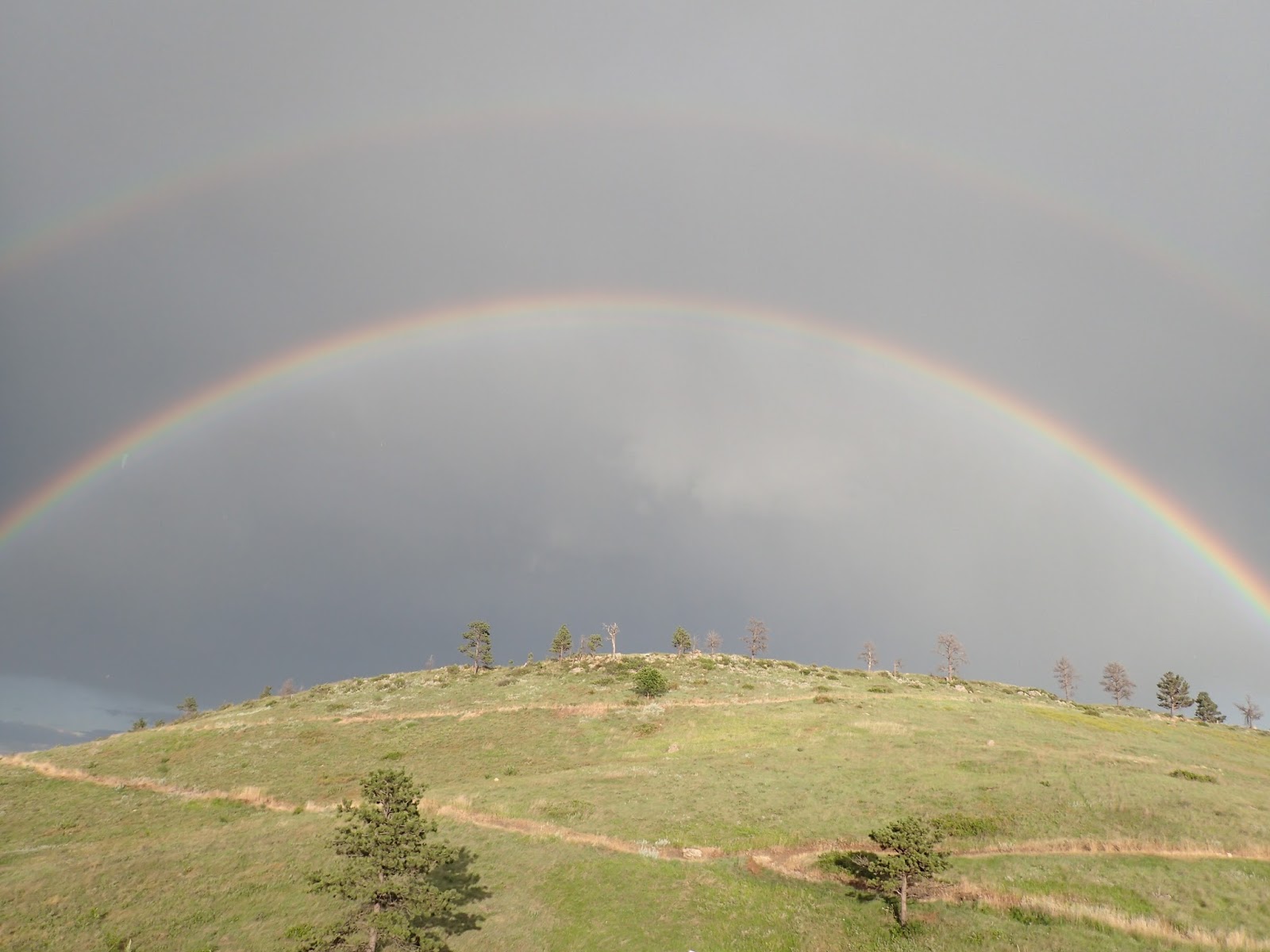
Double rainbow on Sunrise Loop.
Note that the dirt on that side of the valley is nasty when wet.  Practically unrideable.

Yes, M-Hill is single track, but it's primarily IMBA standard, 38 inch bench cut, with 10% maximum grade.  I have ridden all of these routes, and most all of the other trails on M-Hill, on my cyclocross bike with 32 mm semi-slicks, which for me was plenty of tire for Silky Smooth, a bit of a stretch for Into the Valley of Flow (namely, the Horse Shoe loop), and a challenge on Rougher Rider.  If you have a mountain bike, take it.  But you can have a lot of fun on a lot of miles on M-Hill on skinnier tires. 

Finally, don't hesitate to drop me a line.  I'm always up for a ride on M-Hill.

Wednesday, March 23, 2016

Letting Go

Last weekend I said goodbye to an old friend, a companion of many miles.  It was bittersweet, as we had, despite our years of shared experiences, grown apart.  I'm referring to my trusted Torelli cyclocross race bike.

Built in 1999 in a small shop in Italy with classic European cyclocross geometry, this lugged steel beauty turned heads everywhere.  Light, quick and nimble, it accelerated and cornered like a Formula 1 race car.  It was much more bike than I was rider, but I loved giving it all I had.

Surviving the initial lap at the 2003 24 Hours in the Old Pueblo on the Torelli, the first lap on an unknown mountain bike course.  Maybe it was naïveté or arrogance to take that bike out on that course, but I think of it as confidence in the bike's capabilities.  It turned out to be our team's fastest individual lap of the entire race.
Almost immediately, I shed the Ultegra drivetrain to convert to singlespeed, the perfect home for both of us.  I loved riding it so much that I mounted 35 mm slicks on a spare wheelset, so I could commute on it regularly.  I even spun it on a lap at a mountain bike race, the 24 Hours in the Old Pueblo.  But, true to its roots, its strength was cyclocross, which I raced in Colorado and later a little bit in South Dakota when we moved north to the Black Hills.  Boy, was it fast.

The Torelli carried me the length of the 109 mile Mickelson Trail at least once each year since 2006,
including a 218 mile Edgemont-to-Deadwood-to-Edgemont up-and-back ride in 2011.
Over time, I started riding the Torelli longer distances, over rougher roads than my go-fast road bikes could handle.  Then, bit by the gravel bug in 2013, I embarked on a series of long gravel road races, such as the 110 mile Gold Rush, the 170 mile Odin's Revenge and the 150 mile Gravel Worlds.  All that quick handling so fun on a 45 minute cyclocross race was not so endearing on an all day, or longer, gravel road ride.  Yes, one can ride a cyclocross race bike on gravel.  But the geometry, materials and tire clearance of cyclocross bikes are not optimized for such long road rides, so they are not very stable and not very comfortable.

Crossing the finish at the inaugural 110 mile Gold Rush, finishing Third Place Singlespeed (out of 3).
Enter the Black Mountain Cycles Monster Cross bike, with its lower bottom bracket, longer chain stays, slacker seat tube and lower trail, all designed around a fatter 35 - 45 mm tire.  It's basically a relaxed geometry road bike designed for near mountain bike sized tires.  All those individual pieces sing in harmony for all day and night comfort on gravel, dirt and rough roads.

The differences between the Torelli and the Black Mountain are stark.  As I rode more and more longer distance, I rode the Torelli less and less until, finally, I wasn't riding it much at all.  On the rare occasion I rode it a few miles to work, it felt twitchy, not responsive, and wandering, not nimble.  I realized that the only time I would really enjoy riding that bike would be at cyclocross races, which I just didn't do much anymore.

My final photo of the Torelli, shortly before leaving for its new home.
So, I reluctantly put the Torelli on the local market, with the thought that I'd keep it unless the right rider showed up.  Well, it only took a couple of hours.  A 20-something year old mountain bike racer who wants to try cyclocross and maybe some short gravel races.  He's a fellow South Dakota School of Mines & Technology grad, whose dad took him to 24 hour mountain bike team relay races when he was younger.  How could I say no to this kid?

He will inject new life into this classic and both will be better for it.  I certainly was.

Monday, March 14, 2016

Alright. Alright. Tubeless.

Tubeless tires in the mountain bike world are well established, with years of widespread use and standardized components.  Not so in the higher pressure world of road bike tires.  But with the once sharp line between mountain and road blurring, that is changing.

My slippery slope to tubeless road tires started with new wheels for my Black Mountain all road bike.  To better enjoy the sumptuous ride of that bike, I went on the hunt for a strong, relatively lighter wheel set capable of handling rough roads at speed in remote country.  I sought the balance between durability, comfort and weight that won't fold on me 40 miles from cell phone coverage.  That led me to rims with a wider profile and higher spoke count.  Enter the upstart H Plus Son Archetype rim:  23 mm wide, available drilled for 32 spokes, and tubeless ready.  Wheel set upgrade done.

Now, for tires.  Possessing a heightened bias toward flat prevention, I ran 40 mm Schwalbe Marathon Racers on those wheels for over a year, piling up over 5,000 miles, with but one flat.  And that came at the very end, when I kept reverting to those over-worn tires after the performance of prospective replacements fell short.  Then, Schwalbe announced an all-in commitment to tubeless technology, including tubeless tires for road and gravel.  Although leery about the ride of a road tire filled with little knobs and lukewarm at best about tubeless, I ordered the 40 mm G-One.

Up close and personal with the 40mm Schwalbe G-One.
Now, with rims and tires designed for tubeless, what to do?  Install tubes, of course.  For 300 mostly gravel and dirt miles in winter conditions, I rode without losing a single psi.  Then, on my first true spring ride, I collected 3 flats, each from goat heads.  That won't do.  Not surrendering to goat heads.

Back to the Marathon Racers again?  No way.  The G-One is a noticeably softer ride, with greater control.  Maybe it's the higher quality casing.  Maybe the omnipresent knobs.  I don't know.  But the improved ride quality of the G-Ones officially retired the Marathon Racers.

But I'm not about to ride tires that drop their pressure load at the first sight of an Imperial goat head. So, I ditch my retro-grouch tubes and convert to tubeless via Stan.


After kicking the tires, and the wheels, at the dusty Badlands and Buffalo Gap Grasslands proving grounds.

Flawless execution.  A shake out 50 miles and then an all out 110 remote miles with no flats and nary a pressure drop.  Off to a flying start.


Just because I love this bike.

Thursday, February 25, 2016

The Black Hills BackBone - Reboot

Time to reboot.  To put it out there again.  To make it public again, and hopefully make it happen.  Time to commit to ride the Black Hills BackBone in 2016.

Last year at this time, I poured over paper and online maps of all sorts, sifting through a myriad of gravel and dirt roads to craft a route for the Black Hills BackBone.  The concept was simple enough:  ride the height of South Dakota, from the northern border with North Dakota to the southern border with Nebraska, along the spine of the Black Hills, through the best back country, on the best remote roads I could find.

I sketched out a few ideas and set out to ride as much as I could.  Throughout the spring and summer, I rode up, down, sideways, all over and all around the Black Hills and the surrounding prairie.  The draft route took shape, as I found, considered, often rejected and occasionally accepted alternative roads.  Eventually, I committed to a route and posted it.  See Route Overview, Cue Sheets and Maps and GPS.

With all that reconnaissance, I rode the entire Black Hills BackBone, in various bits, pieces and chunks, at some point.  But never in a single ride.  This year, I plan to ride it all, hopefully twice.  Once as a continuous solo ride during the long days of summer.  Once as a three day bike packing trip later in the season.

Regardless of how the year turns out, I'll be out there riding.  Hope to see you out there.