Search This Blog

Monday, July 27, 2020

Cloud Peak 500 - Packing Up

Some folk built like this, some folk built like that
But the way I'm built, you shouldn't call me fat
Because I'm built for comfort, I aint built for speed.

Built For Comfort, Willie Dixon (1959).


Over the past two years, I have ridden a variety of roads, paths and trails on my Jones 29+ bike packed for one and two night trips. But it's time to step up for the Cloud Peak 500. Now I'm packing for an 8 day self-supported ride on unknown remote roads with higher elevations, unfamiliar weather patterns and uncertain re-supply opportunities. Oh, and 40,000 feet of elevation gain.

I need to get this right. Here's my plan for packing the bike for the Cloud Peak 500.


Ready to roll for 8 days in the Big Horns. Just add a rider.

Truss Fork Bags (fork):  In addition to being light and strong, the Jones truss fork provides a built-in structure to support a pair of bags. Recognizing this potential, Jeff Jones and Revelate Designs created these bags, each offering nearly the capacity of a seat post bag. I pack the left side bag with a sleeping bag and a rain jacket. I pack the right side bag with a down jacket, sleeping pad, pillow and a stuff sack of extra layers (liner gloves, head band, skull cap, buff, arm warmers, leg warmers).

Harness + Salty Roll (handle bar):  My small tent occupies less than half the volume of the Salty Roll. So I stuff it into the middle, leaving more than a quarter of the bag remaining on each side for all my clothes.

Egress Pocket (handle bar):  Strapped to the Harness and atop the Salty Roll, the Egress Pocket holds my camera, wipes, toilet paper, paper, pens, and sunglasses/glasses.

Adventure Cycling Map Case (handle bar):  This map case is sized for the Adventure Cycling maps (like the Great Divide Mountain Bike Route), is water-proof, sits atop the Loop Hole H-Bar bag, and doesn't move at all in use. Perfect.

Loop Hole H-Bar (handle bar):  This bag is not visible, because it's under the map case and tucked into the space between the lateral tubes of the Jones handle bar. It is bigger than you think, is a great use of space and is on the bike full time. It holds a pump, first aid kit, sunscreen, lip balm, aspirin, Tums, and insect repellant.

Mountain Feed Bag (handle bar):  Bear spray. Yes, this bag is big enough for a large water bottle, but instead holds a large canister of bear spray a few inches from my right hand. Quick draw.

Mag-Tank 2000 (top tube by the handlebar):  This handy bag holds 2,000 calories of on-the-fly food and gels.

Showing a little dust from the last couple of weeks of riding, the Jones 29+ is loaded for the Cloud Peak 500.

Jerry Can (top tube by the seat post):  This sneaky little bag holds an entire tool kit, including a patch kit, tire plugs, CO2 cartridges, extra sealant, chain lube, extra chain links, bolts and cleats, spare derailer hanger, mini-tool, and LeatherMan.

Terrapin (seat post): This modular setup comprises a harness that attaches to the bike and a 14 liter dry bag that easily removes from the harness. I pack this dry bag with food, so I can readily remove it for overnight storage away from my sleeping area. Think grizzly. As shown, this bag contains breakfast, lunch and dinner for 8 days without re-supply, as well as kitchen utensils.

Frame Bag (main triangle):  The frame bag is divided into top and bottom compartments. The right side of the top compartment holds a 100 ounce water bladder and easily holds more. The left side of the top compartment is a relatively thin sleeve that holds maps, wallet, car keys, phone and mud scraper. The bottom compartment holds spare tubes, water filter and rain pants.

Down Tube Cage:  Strapped to the Salsa Anything Cage on the down tube is my stove and fuel.

Rear Axle Cages:  Bottle cages near the rear axle hold two large water bottles. I use one for an electrolyte drink and one for extra water.

In addition to the bags and their contents, I mounted a Cateye head light and tail light, a Cateye cyclocomputer, and a Stem Captain compass. I also mounted some old, odd-shaped bar ends near the levers on the Jones handle bars for some really different hand positions. The crowning touch is the Slow Moving Vehicle sign strapped to the back.

That's where everything goes. At least at the start.


Built For Comfort, Willie Dixon (1959), 
performed by Howlin' Wolf (1963).

Monday, July 20, 2020

Cloud Peak 500 - Gearing Up

Trying hard now, it's so hard now, trying hard now.
Getting strong now, won't be long now, getting strong now.
Gonna fly now, flying high now, gonna fly, fly, fly.

Gonna Fly Now, Bill Conti, Soundtrack to Rocky (1976).


With my Cloud Peak 500 ride approaching (Cloud Peak 500 - That's The Plan), I hit the month of July with renewed focus and some free time from my recent retirement (Ready To Play). Let's start with riding a fully loaded bike on a variety of single track, rough logging roads and good gravel.

First, spin up M-Hill on my Jones 29+ fully loaded for the Cloud Peak 500.

To start, I load up my Jones 29+ to climb my favorite in-town single track on M-Hill. Spinning up the gentle Far West trail, I stop at the "M" for a quick picture. The loaded bike demands a lower gear and more time to climb, but otherwise handles essentially the same as unloaded. It just takes some extra work to get rolling, but then it really rolls. That is an unexpected and pleasant surprise.

After a short break at the top, I ride down the more technical Sun Climb. Again, once up to appropriate speed downhill, the loaded bike handles essentially the same as unloaded. Maybe the 3.25 inch Vee BullDozer tires, the wide, swept back Jones handlebars, and the absolutely centered, upright body positioning combine for that handling. All I know for sure is that, as long as I maintain some speed, I am able to comfortably ride the loaded bike down everything that I ride unloaded. That's another really nice surprise.

Down Sun Climb, I spin some rolling loops on Far East and Founder's Valley before dropping back to the bike path. The loaded bike basically rides single track like it rode unloaded when I weighed 25+ pounds more. Overall, I am really pleased with the performance of the loaded Jones on the moderate M-Hill single track, at least on this relatively short ride of about 2 hours.

Next, a sub-24 rolling up Castle Creek Road (secondary USFS 181).

The following week, I pull out a Black Hills National Forest map to chart an overnight ride on a variety of rough remote roads. I start mid-afternoon at the Mystic trailhead for the Mickelson Trail and turn onto Castle Creek Road (USFS 181) for 11 miles of rough uphill on a fully loaded bike. Here we go.

Although a secondary USFS road, Castle Creek Road is less technical and less steep than I remember. Although the road is occasionally rutted and pocketed with water-filled pot holes, the loaded bike simply rides through or around everything. It's a nice rhythm spin along Castle Creek. Slow, but steady. Too easy.

Emerging from Castle Creek, I turn west on primary gravel road C306 (Deerfield Road) for a 1.5 mile climb on good gravel and then onto barely marked secondary USFS 190. Over the next 5 miles, the road gets rougher, the grades steeper, and the navigation more challenging. This is much tougher. The loaded bike handles it all with ease, but the added weight catches up with me. Walking some lumpy steeps in the heat, I realize that this bike will ride anything I can pedal. Eventually, I top out on White Tail Peak (elevation 6962') to disperse camp for the night.

In the morning, I quickly drop down to Black Fox Camp Road (USFS 233) and South Rapid Creek Road (USFS 231) to the Rochford Trail Head of the Mickelson Trail. After yesterday's 20+ miles of mostly uphill rough roads, these gentle downhill miles fly by. A final 9 mile spin down the Mickelson Trail returns me to the waiting Jeep. Through all those varying conditions, the loaded Jones just handles it.

Then another sub-24, starting with a nearly 20 mile climb up to Warren's Peak.

Time to ride gravel. Not our typical Black Hills Forest Service gravel sprinkles. Honest to goodness ball-bearing gravel.

It's time to hit the Bear Lodge Mountains, the northern-most reach of the Black Hills just north of Sundance, Wyoming. For some reason, the U.S. Forest Service actually spreads substantial gravel on the main roads up there. In addition, those roads offer long, fast descents on twisty, occasionally washboarded roads. It promises to be a good test for the loaded Jones.

I start at the USFS Bear Lodge campground and ride south on Warren Peak Road. Up. Up. Up. Basically, it's 6 miles up, a few rollers, and then another 6 miles up. And that's still not the top of Warren Peak. The loaded bike climbs OK, but it's heavy and those 3.25" mountain bike tires don't help. Uphill is a slugfest.

Turning downhill, however, tells a different tale. Once up to speed rolling downhill, the loaded bike absolutely cruises through thick gravel, over washboards, and around twisty turns. Bring one, bring all. It matters not. I regularly hit 25-30 mph, sometimes more, with confidence and comfort. The loaded Jones is one stable, comfortable, fast descender, even in those conditions. More to the point, especially in those conditions.

Ecstatic with the downhill performance but concerned about the uphill, I recover by campsite and plot the morning's ride. I conclude that today's 40 miles and 4,000+ feet of elevation gain provided sufficient gravel testing. With so much good gravel and so many rough ATV connectors up there, I decide to scout as much as I can the next day, by both bike and Jeep. I even drive by Devil's Tower National Monument on a short swing to the west. There's just so much to ride out here.

Wyoming gravel road (County 196) from the Bear Lodge Mountains to Devil's Tower National Monument.

Whether single track, rough logging roads or good gravel, the Jones 29+ can easily handle a bike packing load, as long as you provide the additional horsepower. In the end, I may limit the bike, but this bike will not limit me. Gearing up to fly.


"You'll able to spit nails, kid. You're gonna eat lightening and you're gonna crap thunder."
Gonna Fly Now, Bill Conti, soundtrack to Rocky (1976).


Wednesday, July 15, 2020

Ready To Play

Put me in Coach. I'm ready to play. Today.
Centerfield, John Fogerty (1985).


Shaun Arritola, Craig Groseth & Rob Sorge at the end of our 5 day, 300+ mile DED Dirt Ride in 2014,
which was part of Rob's start to his "Second Half."

Several years ago, Rob Sorge, my best friend from college, retired after a successful 33+ year career as an engineer. At that time, Rob thoughtfully created an outline, or perhaps more of a conceptual framework, on how to live the next phase of his life with intentionality and purpose. He called his post-retirement phase "The Second Half" and shared it with family and friends. Ever since, he has relentlessly pursued his "Second Half," just like he pursued a loose ball on the basketball court, a baseline bullet on the tennis court, or a finish in the swimming pool.

In a recent congratulatory note to me, Rob noted that now I was entering my "The Second Half." He then added that, for me, maybe it's my "Third Quarter." At first, I thought he was referring to my playing football and basketball, which both had four quarters.

But, no. Rob wasn't referring to sports. My First Quarter was everything leading to and including a 21+ year career in the private practice of law as an intellectual property law litigator. From the start, I had the heart, mindset and lifestyle of go/go/go, achieve/achieve/achieve, next/next/next. Shoot for the top, the hardest, the best. Excel. Move up. Move forward. Move on. Next.

Eventually, I realized that working so hard to achieve makes it difficult to recognize success, let alone enjoy it. At age 47, I radically changed. All of it. Heart. Mindset. Lifestyle. I extracted myself from all of that and started my Second Quarter.

Centerfield, John Fogerty (1985).

We moved to Rapid City, South Dakota, my wife's hometown, and I began to search for a unmet community need. In a wildly unexpected development, I was led to serve our community as a Correctional Officer at the Pennington County Sheriff's Office. Now, there's a community service need that very few are able or willing to undertake, let alone endure for any length of time. It is a difficult environment that demands interpersonal communication skills and situational awareness far beyond the court room. Despite the challenges, I loved the opportunity to serve and I loved the people.

However, it's also a young man's game, which I played at my best for 12 years. But I can't play forever and the clock eventually expired on my Second Quarter. Closing in on age 62, I recently retired from the Pennington County Sheriff's Office.

Now, it's my Third Quarter. I do not know where this will lead. I do not yet have an outline, other than a determination to keep an open heart, being especially attentive to a call to serve an unmet need.

Put me in, Coach. I'm ready to play. Today.


Tuesday, July 7, 2020

Why I Ride, by Calvin's Dad

In a favorite comic strip "Calvin and Hobbes," Calvin's dad is a patent lawyer who loves to ride his bicycle.

This one from 1992 depicts how I feel on a bicycle, most any day over the last 30+ years. It's still timely now, as I recently retired from my second career.

Calvin's mom also sounds much like Colleen responding to my musings.

Have fun out there, whatever comes your way.


Tuesday, June 30, 2020

A Final Commute

Today is my last day riding my bike to work. That's because it's my last day of work, at least in this career. Today I officially retire from the Pennington County Sheriff's Office.


Riding downstream on the bike path along Rapid Creek past M-Hill and then toward the sun to downtown Rapid City.

For the past 12 years, I have ridden a bicycle to work practically every day. Not absolutely every day, but practically every day.

With shifting work responsibilities and a maturing family, one constant throughout the years was cycling. Every day, I hopped on my bike and rolled through our neighborhood, grinning in disbelief that I got to ride my bike that day. As if dipped in magic waters, I'm 12 years old riding to the park to play baseball with my friends.

After a shift, or a shift and a half, working in a demanding environment, I hopped on my bike and rolled home. Two rides in one day! Somewhere along the way, work troubles always seemed to drop off the back. They just couldn't hang with the pace of the good vibes pulling me along.


"It'll be as if they dipped themselves in magic waters. The memories will be so thick, 
they'll have to brush them away from their faces." Terrance Mann, Field of Dreams (1989).


Cycling travels at a human level. I loved seeing and greeting all kinds of folks along the bike path that formed a large portion of my commute. Even in the depths of a western South Dakota winter, folks are out, throughout the day and night, enjoying the bike path for recreation and transportation.

The most regular of the regulars, however, was cyclist Bill Marquadt. A retired 70-something year old, Bill rides almost 50 miles every day, year round, totaling somewhere around 16,000+ miles per year. When I rode in at about 6:00 am, I often saw him riding home. We regularly stopped to chat for a moment, so I may need an early ride now and then to catch up with Bill.

A fun, little side trail along the other side of Rapid Creek on the base of M-Hill.

The newest regular along my commute was Lucas Haan, an enterprising young School of Mines engineer with a passion for all things cycling and beer. Last winter, Lucas successfully completed the Icy Bike Winter Cycling Challenge by commuting 81 days during our 6 month winter. He even arranged his schedule to share with me part of his ride home. I may need to arrange my retirement schedule to occasionally ride in with Lucas.

Riding my bike to work simply started as a way to get to work. It became an integral part of my lifestyle. I will miss it.

Entering downtown Rapid City as the city awakens.


Saturday, June 20, 2020

Stop The Madness

For four wonderful years, I blissfully rode my geared Black Mountain Cycles MonsterCross for thousands of miles on many long, remote road rides and races. Then, for some inexplicable reason, I converted it to single speed for the 2018 Gold Rush Gravel Grinder. A Single Speed Gold Rush.

Good. I got that out of my system and switched back to gears.

Black Mountain Cycles MonsterCross after its 75 month/25,000 mile tune up in June 2020.

Hold your horses. Guitar Ted announces a single speed only race on the storied gravel roads of central Iowa in March 2019. Really? OK. I'm not about to miss that. Back to single speed for the C.O.G. 100. A Fine Mess. And, since I'm at it, let's go for the first attempt of the 210 mile Mother Lode single speed. Arrogance At The Mother Lode.

How did this happen? This is nuts. I thought I beat this single speed addiction back in 2014 with that sweet geared Black Mountain Cycles MonsterCross.

But it doesn't stop. I continue to ride single speed throughout the 2019-2020 winter to prepare for the 150 mile Buffalo Bill Rough Rider Gravel Grinder. And then it's single speed throughout the 2020 Black Hills Gravel Series to date and the 110 mile route of the Gold Rush Gravel Grinder. Not A Virtual Ride.

Black Mountain Cycles MonsterCross, set up single speed at Trailshead Lodge, O'Neil Pass, South Dakota,
the 70 mile checkpoint of the 110 mile route of the 2020 Gold Rush Gravel Grinder.

Enough already. Long, remote rides on rough roads are tough enough with gears.

Here's a novel concept for 2020. Stop the madness. Check the emotion. Control the ego. Engage the intellect.

Get your gears back on.

So, I rebuild the Shimano 105 hubs and buff the H Plus Son Archetype rims on my geared wheel set. I then install a new set of 40 mm Schwalbe G-One Bite tires. As I start on gears, a closer look at the rest of the bike stops me cold. This bike needs much more work.

One long afternoon last week, I take most everything apart, clean everything, inspect everything, switch out the Salsa Cow Chipper handle bars for Salsa Cow Bells, wrap new bar tape, install front and rear derailers, and replace the brake pads, brake cables, brake housing, shift cables, shift housing, chain, and cassette.

The result? Coasting down our driveway, before even shifting gears, I smile ear to ear. Yes. This is how this bike is meant to be. Smooth. Comfortable. Familiar. It's like slipping into sneakers and stepping up to the free throw line. The difference is not the addition of gears, but the change of tires. I finally replaced those awful Teravail Cannonballs, which have to be the harshest tires I've ridden since racing 21 mm slicks at 130 psi years ago. Thank you, Schwalbe for your G-Ones!

Refreshed Black Mountain Cycles MonsterCross, set up geared for all day riding on rough remote roads.
Now adorned with custom color top tube bag and frame bag from DirtBags Bikepacking.

Now with gears, maybe I can actually ride gravel more with others. And maybe I can ride a few overnight or longer light bikepacking trips this summer. And maybe I can keep gears on this bike for awhile. Maybe.


For an earlier post about the Black Mountain Cycles MonsterCross bike, go to A Road Bike By Black Mountain Cycles. For my 2016 series of posts about its 30 month, 12,000 mile overhaul, go to It's Time - Overhaul (part 1), Frame & Fork (part 2), Wheels & Tires (part 3), Drivetrain (part 4), Brakes & Shifters (part 5), Controls (part 6), On The Road Again (part 7).

Black Mountain Cycles MonsterCross after its 30 month, 12,000 mile overhaul in 2016.


Why, Annie Lennox (1992).

Sunday, June 7, 2020

Not A Virtual Ride

Give me your heart, make it real, or else forget about it.
Smooth, by Itaal Shur & Rob Thomas, performed by Santana (1999).


My 2020 Gold Rush Gravel Grinder is in the books. The real route. On real gravel. Through real mud. Over real rocks. Against real wind. In real heat. With real sunburn. And, in the end, real tired.
No virtual ride here. 

Hard Forest Service gravel abounds at the Gold Rush Gravel Grinder in the Black Hills of South Dakota. 

Like events of all kinds all over, the Gold Rush Gravel Grinder will not occur in 2020, due to uncertainties with governmental licenses and permits. Gone is the pre-race gathering, the mass start, the check point enthusiasm, and the post-race festivities at a city park. There will be no Gold Rush block party this year.

Determined to make the most from a bad hand, Race Co-Directors Kristi and Perry Jewett create an alternative event. One can participate in a "virtual" Gold Rush by riding one of the four race distances (45, 70, 110 and 210 miles) on any route, anywhere, between June 1-15. Kristi and Perry will post "results," ship out event schwag, and even award door prizes and other awards.

Kristi and Perry are doing what they can do, making the most of it for everyone. And I understand others choosing not to gather in large groups or to travel to the Black Hills for a bike race. But I live here. I ride many miles solo. I've looked forward to this all year.

So, I enter the "virtual" Gold Rush Gravel Grinder to ride the actual race course. Solo. Single Speed. Self-supported. Self-navigated.

The event is "virtual," but my ride is real.

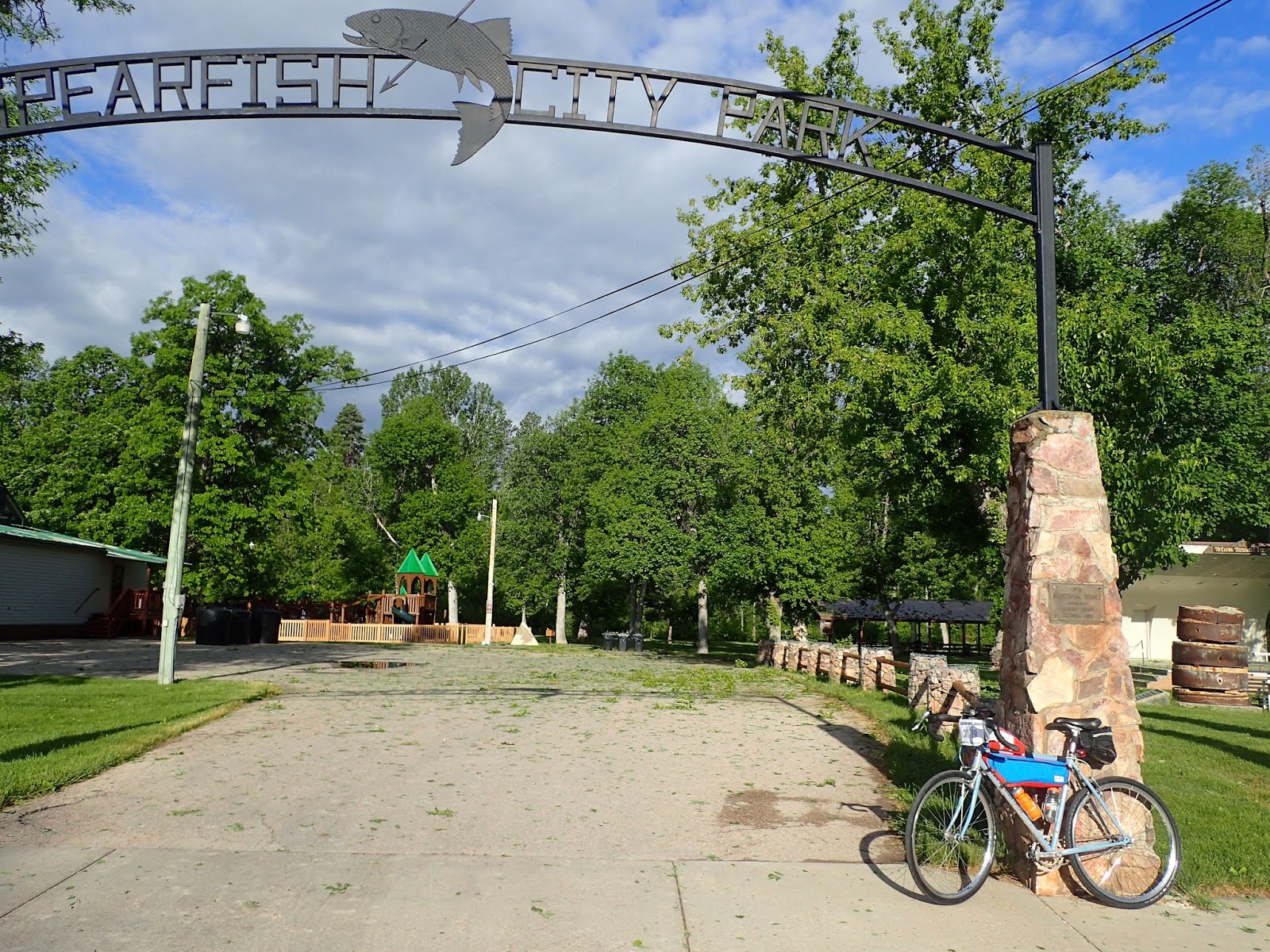
The start of my "virtual" Gold Rush Gravel Grinder from an empty Spearfish City Park.

With a late start to clear the vestiges of last night's hail storm, I arrive at Spearfish City Park full of anticipation. The "virtual" weather as forecast and the real weather outside actually match with relatively clear skies, no wind and 60 degrees. The day promises to be very good.

It's oddly quiet and a bit eerie to stand at a Gold Rush start line alone. Memories flood my mind of many starts here, with many friends, both old and new. I see their excited faces and hear their friendly chatter. Abruptly, a crowing rooster breaks the clutter and a familiar voice shouts "PEDAL POWER!" I look around. The park is empty. The streets are empty. So, I quickly reply, "Pedal Power," take off and don't look back. 


From Spearfish heading west into Wyoming, the gravel roads still hold water from last night.

As the sun burns off the last of the cloud cover, I roll through the early prairie miles below big, blue skies. Before long, I turn onto Sand Creek Road for a serene 22 mile climb along a quiet creek. This pretty, protected stretch of gentle uphill offers a great opportunity to settle into a sustainable rhythm and just enjoy the ride. My mind drifts.

What's that? A cyclist! Flying down Sand Creek Road toward me! It's Angie Kent from Spearfish, out riding her own "virtual" Gold Rush event. What a nice surprise. We chat for a few minutes before returning to our individual journeys. That brief encounter lifts my spirits for miles.


Spearfish cyclist Angie Kent on her own "virtual" Gold Rush Gravel Grinder.
Great to see you, Angie, and congrats on your successful ride!

Emerging from Sand Creek Road at mile 36, I stop at would have been a Check Point/Aid Station brimming with encouraging volunteers and baked treats. Although now there's nothing but a remote intersection, I take a break, stretch, and eat a little. I'm right on track for me, a little over 3 hours into the ride and starting to warm up.

Looking ahead, Moskee Road looms large, with some significantly steeper rollers and then rougher road along the ponds. After a couple of hours of steady climbing along Sand Creek, I always enjoy this stretch of short, hard uphill pulls and screaming descents.

OK. Short stops are great, but long stops will break. Time to roll.


Spinning up Sand Creek Road on the Gold Rush Gravel Grinder.

By the time I turn southeast onto Grand Canyon Road, both the sun and wind are fully awake. My cycle computer reads 94 degrees and a stiff, steady headwind greets me for the final 20+ mile climb to the next Check Point at O'Neil Pass. There's not much to do now, but keep pedaling up the hill, in the heat and into the wind. Here lies the heart of the ride.

About half-way up that final climb to O'Neil Pass, at about 60 miles into the course, Grand Canyon Road turns decidedly upward. Not only steeper, the road also straightens out to flaunt its might. It simply looks endlessly up. Gut check time.

Keep at it. Keep pedaling. Walk if you must. Keep moving. There is a summit. You will make it.


Nearing the 70 mile Check Point at O'Neil Pass, after a whole lot of uphill, upwind, hot gravel.

Eventually, I reach Trails Head Lodge at the top of O'Neil Pass. Rather than check-in, re-load, and dash, I plop down for a cheese burger, french fries and a bottomless Coke. No, that's not premium racing fuel. But I'm not racing anyone, anyhow. Today, I'm out riding my bike.

After an exceptionally long break, I ease onto the roads for the 40 mile descent home, starting with 9 downhill miles on Rifle Pit Road. But even that doesn't come easy. This rocky, rutted, rough, often barely-a-road is no time to relax. I bounce all over, checking speed to avoid breaking bike or body. At least this year it's mostly dry.

Of course, there are a few uphills along the way down to Spearfish, particularly that nasty pitch up to the last Check Point at the Cement Ridge Lookout. But now, the heavy lifting is done. After a spell, it's a spun-out coast down Roughlock Falls Road and then Spearfish Canyon.

Cooked by the sun, battered by the wind, and worn down by the hills, I am done for the day. My 2020 Gold Rush Gravel Grinder "virtual" event is complete after riding a very real 110 miles in just over 10 hours.


The most bellicose, unruly gang of wildlife I've seen since the virus.


Give me your heart, make it real, or else forget about it.
Smooth, performed by Rob Thomas and Carlos Santana (1999).