The F-18 NATOPS contains everything they want you to know about your aircraft.
I'm assuming you know the book, inside and out.
(tosses book into trash). So does your enemy.
But what the enemy doesn't know, is your limits.
I intend to find them. Test them. Push beyond.
Captain Pete "Maverick" Mitchell, Top Gun Maverick (2022).
Fully loaded for an overnighter, the Ronin flies on Primary roads.
All summer I've been riding my new Alchemy Ronin gravel bike on an mix of pavement, prairie county gravel, Black Hills dirt, and even single track. It's light, fast, and agile. And a whole lot of fun.
Even with a big technology update over my older bikes (seeNew Bike Day), I find that my biggest adjustment is its weight. At 18 pounds, the Ronin handles so differently from my much heavier steel bikes, especially when navigating around and over obstacles. Not necessarily better or worse, just different.
One afternoon, while bouncing over rough Forest Service roads exploring my limits of fun on a feather weight drop bar bike with 45 mm semi-slick tires, I realize that summer is quickly fading. Flying up the schedule is the Pony Express 120 Bikepacking Adventure, a two day event that I rode two years ago on my Black Mountain Monster Cross. 2020 Pony Express Bikepack. I wonder if the Ronin is up for an overnight load.
Onto a Low Standard road, the loaded Ronin just handles it.
So, I assemble bags and gear for a 120 mile warm weather overnighter on north-central Kansas county gravel roads. Compared to a multi-day or multi-week self-supported bikepacking ride, my sleep kit, cold and rain clothes, tool and repair kit, food, and kitchen are significantly scaled back. I'd call it appropriately minimal for the Pony Express ride.
All my gear fits into three Revelate Designs bags: the Salty Roll and Egress Pocket on the handle bars and a 14L Terrapin on the saddle. A small Gas Tank on the top tube holds on-the-go food. With judicious loading, the Ronin feels pretty well balanced, fore and aft. This may work.
Topped off with 2 liters of water, the loaded bike weighs in right at 37 pounds, about one-half the weight of my loaded Jones 29+ at the start of the Great Divide Mountain Bike Route last summer. That's good, as I'm currently probably at one-half the strength and conditioning as then.
A view of the south side of Buzzard's Roost, a popular single track trail system.
Starting out on a USFS Primary road, I certainly feel the extra weight, but it's all relative. At 37 pounds, the loaded Ronin weighs about what my Jones 29+ weighs with a couple of water bottles and a few M&M's. Other than taking a little more work to get up an incline, the extra weight matters not. The Ronin rides straight and smooth, undisturbed by the light gravel and uneven surface.
More specifically, the Ronin handles solidly on the Primary roads, perhaps even a bit more stable loaded. It does not wander through loose gravel and is not skittish over washboard. Onto a series of USFS Low Standard dirt roads, I work more of the road to ride a suitable line and the Ronin just handles it.
The loaded front end feels different from my Black Mountain Monster Cross, which features a relatively stiff aluminum stem and handle bar coupled with a gently sloping steel fork that visibly moves to absorb vibrations. The Ronin carbon fork feels much stiffer, but the carbon stem and carbon handle bar feel much more active, which I had not noticed so much unloaded. That's a pretty long head tube, so the titanium frame probably contributes, too. I don't know.
Overall, the ride seems to be comparably comfortable to the famously comfortable Black Mountain. More time in the saddle will test this initial conclusion, but so far, so great. And, yes, the Ronin is headed to Marysville, Kansas for the Pony Express 120 Bikepacking Adventure.
Sun in the sky, you know how I feel Breeze driftin' on by, you know how I feel It's a new dawn, it's a new day It's a new life, for me And I'm feeling good Feeling Good, Leslie Bricusse & Anthony Newly (1964)
Alchemy Ronin at home on dirt at Green Mountain Open Space Park in Jefferson County, Colorado.
After picking up my new Ronin Titanium gravel bike at Alchemy Bikes last Wednesday, I started pedaling on my first ride at about 11:00 am and didn't stop until almost 6:30 pm. Wow. What a ride.
I flew along the Cherry Creek, South Platte and Bear Creek Trail bike paths to eventually reach the single track at Bear Creek Lake Park near Morrison. Those bike path miles were fun and fast, but the Ronin really came alive on the skinny dirt roads that park calls trails. Spot on fit, precise handling, silky smooth ride. Awesome sauce.
The next day I rode another two hours up and around Green Mountain Open Space Park in Jefferson County. Those skinny dirt roads were generally rougher, rockier, and steeper than Bear Creek Lake, but certainly nothing that the Ronin didn't handle with ease.
This is going to be fun. I can't wait to get it out on Black Hills forest dirt and Badlands gravel.
I will post more details and impressions as I ride this beauty, but for now, here are a few pictures and the specifications.
Working in my bike during Alchemy's company move, Bryce adjusts my saddle precisely to design.
On my first ride, I reach dirt at Bear Creek Lake Park after a 20+ mile bike path shake down.
Alchemy Ronin rocks Green Mountain Open Space Park on my second day's ride.
The Green Mountain Tail is about to turn steeper and looser. No problem.
Here are the specifications of my Alchemy Ronin Titanium gravel bike.
Social media image by Alchemy Bikes building a custom titanium frame.
ronin (roe' nin), noun,lit "wave man," a lordless Samurai in feudal Japan, also drifter or wanderer
Custom fit. Custom geometry. Custom tube shaping. Custom Cerakote. Custom build. Hand crafted in Colorado. Developed over decades of riding and brought to life by custom frame builder Ryan Cannizzaro. Shimano GRX Di2 drivetrain, Industry Nine UL 250 Trail Carbon wheels, and carbon bits.
Alchemy Ronin Titanium. The wait is nearly over. Time to wander a bit more.
Social media image by Alchemy Bikes of a Ronin Titanium at Red Rocks, Colorado.
The Waiting, Tom Petty & The Heartbreakers, featuring Eddie Vedder (2006)
Single speed sweetness at the 2019 Black Hills Gravel Series Sugar Shack ride.
In 2014, I built up a Black Mountain Cycles MonsterCross frame into a bike for riding all kinds of roads in all kinds of conditions. An All Road Bike (2015) and A Road Bike By Black Mountain Cycles (2018). A key feature leading me to that particular frame was its old school semi-horizontal dropouts, which allow easy conversion from gears to single speed, even in the field. Make It Single Speed.
Over the past 8 years, I have ridden my Black Mountain over 30,000 miles, mostly on gravel and dirt roads. I love to ride that bike, confident that it will take me through anything. See, e.g., Odin's Revenge 2012-2016 and Stretching The Notion Of Rideable. It is the most comfortable road bike I have ever ridden and really shines set up single speed, which I regularly do, just because. Single Speed, It Is.
My 2014 Black Mountain MonsterCross bike, fresh off its 12,000 mile overhaul in 2016.
It all worked well enough, but eventually I realized that did not very often take the time to switch between geared and single speed. Then, a few years ago, Salsa announced the arrival of the Storm Chaser, a single speed gravel bike designed from the ground up for long rides in bad conditions on rough roads. Uffda. I almost bought it to allow the Black Mountain to be a dedicated geared gravel bike. The N+1 Struggle Is Real.
But I did not buy that Storm Chaser. Ultimately, I concluded that I really didn't want it, mainly because my Black Mountain is such a sweet single speed. So, I committed to continue to switch back and forth.
Now, I decided to simply dedicate my Black Mountain to full time single speed. That's where it really shines. And I can cruise into single speed bliss on a moment's whim.
A new geared bike is in the works, but it's not N+1. It's more like e to the nth.
And it makes me wanna take a back road Makes me wanna take the long way home Put a little gravel in my travel Unwind, unravel all night long
Take A Back Road, Rhett Akins & Luke Laird (2011)
After several summers of solo weekend bikepacking rides throughout the Black Hills, I enjoyed a week+ trip around the Big Horn Mountains of Wyoming with cycling buddy Paul Brasby. During that trip, Paul described a bikepacking event he was adding to an existing gravel grinder.
What? Adding a bikepacking event to a gravel grinder? What does that look like?
Paul Brasby leads the Friday group bikepacking ride out to the campground at Sabetha City Lake. (photo by Pony Express 120 Gravel Dash)
The Pony Express 120 Gravel Dash is an annual race in the historic town of Marysville, Kansas. With passionate, dedicated individuals planning and managing the event, the Pony Express has developed a growing cult following among area cyclists as a must-ride at the end of the year's gravel calendar.
The signature event is a 120 mile gravel race on a wide variety of gravel/dirt roads fanning out from the first Home Station of the famous Pony Express of the Old West. For those looking for less saddle time, the Pony Express also offers a 70 mile race and two different relays - a 3 person relay to cover the 120 mile course and a 4 person relay on the 70 mile course. Pony Express 120 Gravel Dash.
Paul knows this event thoroughly. In fact, he created the Pony Express 120 Gravel Dash, co-directed it for its first 5 years, and just this year turned it over to locals. For 2020, Paul suggested a bikepacking event that would leave the morning before the main event, ride along the 120 mile route, camp somewhere about half way, and ride back the next day to finish along with everyone else. In another twist, the Friday ride out to the camp would be a non-timed group ride, while the Saturday ride back would be a timed race for those that wanted to compete. Now, how about that?
Paul Brasby leads the start of the inaugural Pony Express 120 Bikepacking Adventure. (photo by Andrea Skalla)
After a spring and summer of riding solo, very small group rides, and "virtual" events, the prospect of riding in an actual event with others certainly is appealing. The Pony Express also sounds like a well conceived and executed gravel event, especially with this intriguing Bikepacking Adventure. But it's Paul's role in the event that drives me to find my way to Marysville, Kansas in the middle of October.
Paul co-directed the Pony Express with the Marysville Chamber of Commerce for the first five years and the small town really responds. Seemingly half of the town's weekly newspaper is devoted to the event and "Welcome Gravel Dashers!" signs adorn businesses all over. The City Park even fills this weekend with many cyclists and their families camping in RVs and tents. It's the event of the weekend.
Cruising a Minimum Maintenance Road during harvest season in northern Kansas.
The bikepacking event rules are pretty straightforward. Carry what you want for food, clothing and camping, but you'll have to carry it the entire event. You can utilize the aid stations set up for the main event and also stop at commercial establishments along the way, if any. But I'm not relying on unknown resupply and I'm not cutting corners. As a non-racer who enjoys hot meals and relative comfort on and off the bike, I will carry my typical autumn sub-24 gear and plan to resupply nothing but water.
For this two day/one night event on a gravel race course, I choose my beloved Black Mountain Cycles MonsterCross bike with 40 mm Schwalbe G-One Bite tires. It's built for this terrain and comfortably carries everything, including tent, sleeping bag/liner/pad/pillow, rain gear, clothing, stove, food, and 4.5 liters of water. When ready to roll, it weighs 47 pounds. No fly weight, but all business.
Flying into Summerfield, the first and only checkpoint of the first day.
Sixteen intrepid bikepackers roll out of Marysville on Friday morning, bound for Sabetha City Lake to camp. It's a jovial, talkative group excited to be out riding together on a crisp autumn morning. The route starts on the Blue River Rail Trail before turning onto fast gravel occasionally connected by dirt Minimum Maintenance Roads. If wet, this course could be Mr. Hyde, but today it's all Dr. Jekyll.
Mid-October is harvest season in northern Kansas and combines, tractors and trucks fill the countryside. More than once, I stop to let a procession of big rigs amble by. I welcome the short breaks, knowing that the industrious farmers are the reason these roads exist and I get to ride them just for fun.
The winds build throughout the morning, growing into a substantial, steady westerly. Turns out that's a big tailwind for most of our ride today. With the strong prevailing winds, fast roads, and relatively light gravel bike, I'm rolling 12-15 mph with little effort. Nice.
Before long, I pull into the 27 mile checkpoint in the town of Summerfield. In addition to water, some local volunteers offer the cyclists Halloween candy from a ginormous bag. What a treat! Since chocolate doesn't travel very well on a bike, I indulge right there. Sweet!
Good thing this Minimum Maintenance Road is dry.
The miles roll by easily, at least until Brewsky Hill. No, it's not a monster climb in length, but it is steep. So steep, in fact, that a sponsor offers a free beer to anyone that rides it without stopping. I give it a go, but don't get far. Remounting to try again, I fall after a couple of pedal strokes and stumble all the way to the bottom before catching my balance. OK, that's it. This is the only time all day that I would have preferred my Jones 29+ with mountain bike gearing.
After a delightful 73 miles, I soft pedal into the camp ground in mid-afternoon and set up camp. Camp host Jon Naaf checks on the bikepackers riding in and creates a central gathering place near his camper by the lake, with a picnic table, chairs and a roaring campfire. Once he accounts for all riders, Jon unexpectedly grills hamburgers and hot dogs, provides beverages, and awards a door prize to each rider. Even better, he later facilitates a round-the-campfire introduction of everyone there. Nice.
Gathering at a city lake, bikepackers attract the attention of the local constable.
Just as the party's getting started, a Sabetha Police Officer drives up to check out a report of "about 20 bikers" hanging out at the city lake. Even the local EMT shows up, just in case. Jon addresses their concerns and happily announces that no charges will be filed.
The informal gathering stretches into the evening, as few wish to leave the warmth of the campfire and the company surrounding it. A little community builds, as new friends connect and old friends re-connect. Jon recounts the story of his wife Amy, who recovered from cancer and started the organization Pink Gravel to help others recovering from cancer return to active lifestyles. Pink Gravel is out in the community, raising awareness, encouraging folks, and volunteering at events such as the Pony Express 120 Gravel Dash. That's some community service. See her website Pink Gravel.
Warm fire and conversation at Sabetha City Lake.
Eventually, all the bikepackers head to their tents and hammocks. Well, all but one. Todd Frye, a local cyclist active in the nutty Black Squirrel Cycling League, left his tent at the start. That actually was intentional, because he did not like how the tent's weight affected his bike's handling and figured a tarp would be enough shelter. Then forgot to load the tarp onto his bike. Only after arriving at the campground did he realize his mistake.
With temperatures dropping into the 40's and below, Todd knew he was in for a long, cold night in his sleeping bag in the open air. Determined to stick to the ethos of the bikepacking event, he refused offers of help and hunkered down in a shallow ditch. Then, in the middle of the night, a front blew in like a freight train and kicked winds up to a steady 25+ mph. I don't think he slept much after that.
Here I'm enjoying a cup of hot coffee while the racers take off on the second day. (photo by Pony Express 120 Gravel Dash)
In the morning, the persistent wind creates all sorts of problems for everyone. Tents and ground covers billow. Stuff sacks scoot away. Hats tumble across the grounds. Stoves blow out. The biggest problem, however, is that steady 25+ mph wind will be a direct headwind for much of our 52+ miles today. That's going to take some work. Most of the bikepackers seem to respond with a silent shrug and continue to prepare for the ride ahead.
Shortly before 7:30, I deliberately sit at the picnic table by the lake and fire up my stove to make a fresh cup of coffee. I'm sitting out the race start. If I line up for that 7:30 start, I know I'll get caught up in racing. Not that there's anything wrong with that, but that's not why I'm here. So, at 7:30 I cheer on those starting the race back to Marysville and enjoy the rest of my coffee.
Winding our way back to Marysville on the second day.
Maybe 20 minutes later, I meander out of the campground as one of the last bikepackers to leave. The day breaks overcast, cool and windy. But I slept warm and well, savored a hot breakfast and am dressed for the conditions. I settle in for a relaxing 52 mile tour of the Pony Express countryside.
The idyllic, protected start around the lake soon climbs out of tree cover and emerges onto the fruited plains. No hiding from the wind here. I'm pedaling up and down rolling farmland directly into that big headwind. OK, so this is what the day is. I find a sustainable rhythm and enjoy the passing scenery.
At the Axtell checkpoint on the second day, riders on the 70 Mile course merge onto the 120 mile course. (photo by Andrea Skalla)
I pass a few of the other non-racing bikepackers, several of whom are struggling with the early hills and wind. The return ride on the second day ultimately proved more difficult than expected for many, as only 10 of the 16 bikepackers starting today ultimately pedaled back to Marysville.
Cruising into the check point at the town of Axtell, I stop to refuel, rehydrate and stretch a bit. The park is buzzing with activity, with cyclists from today's 70 mile course streaming in to merge with the 120 mile route. Volunteers scurry about, taking care of everyone. I refill my water bottles, sit down against a fence by the road, and close my eyes. This is good . This is really good. Fully 20 minutes pass before I move again. Oh, yeah. I still need to eat and drink. OK, I will. Ahh. This is good.
Paul Brasby and Craig Groseth at the finish of the 2020 Pony Express 120 Bikepacking Adventure. Paul finished 3rd to claim a podium spot. FWIW, I finished 7th.
The rest of the ride continues to roll through picturesque rural Kansas, up and down good gravel roads and more than occasionally dip into a dirt road connector. The main difference today is the persistently heavy headwinds and, after the Axtell check point, the presence of the 70 mile riders, including a couple of old Nebraskans.
First, Rob Evans of Omaha flew by, then slowed to chat, before disappearing over the next ridge. A little later, Joe Billesbach of Beatrice did the same. Both interrupted their race to re-connect a bit, even as they were clearly racing. I later learned that Rob rode as part of the winning 120 mile relay team and Joe won the 70 mile fat bike race. Thanks for the hospitality, boys. I'm glad it didn't cost you a win!
Now that's a lot of stuff from one event. Clockwise from the upper right: 3/4 length event t-shirt, custom bikepacking finisher's cup, buff, number plate, liner gloves, local newspaper, mud stick, titanium spork, Pony Express "mail" to carry through the checkpoints, custom face mask, cue sheets, and 3/4 length Pink Gravel t-shirt.
The 120 mile course is quickly running out. Soon I'm back on the Blue River Rail Trail for the final few miles into Marysville. I'm not sure that I'm ready for all this to end, but I soft pedal through the finish line. There's Paul, waiting. He's excited for me, but he's also cheering for every rider coming in. Later I learn that Paul raced hard and smart all day to grab third place in the bikepacking race. Nice.
Riders of all kinds filter through the finish line over the next several hours. I hang out for the energetic post-race festivities by the newly restored Union Pacific Train Depot. There's plenty of drinks and snacks, but the homemade apple caramel pie and vanilla ice cream is simply scrumptious. I consider myself abundantly disciplined to consume only two servings. At a volunteer's table, I find my event schwag bag filled with all sorts of stuff, including a titanium spork and a "Marysville Mud Stick." Better yet, I receive a custom finisher's cup for the Bikepacking Adventure. How cool is that?
Thanks to race co-directors Mark and Renee Hoffman, the rest of the Black Squirrel Cycling League, and the Marysville Chamber of Commerce for running the 2020 Pony Express 120 Gravel Dash! Well done, folks! Thanks also to all the sponsors, the volunteers and the cyclists out there pedaling through that wind! And special thanks to my cycling buddy Paul Brasby for drawing me out to Marysville, Kansas to experience a slice of heaven known as the Pony Express 120 Gravel Dash.
For four wonderful years, I blissfully rode my geared Black Mountain Cycles MonsterCross for thousands of miles on many long, remote road rides and races. Then, for some inexplicable reason, I converted it to single speed for the 2018 Gold Rush Gravel Grinder. A Single Speed Gold Rush.
Good. I got that out of my system and switched back to gears.
Black Mountain Cycles MonsterCross after its 75 month/25,000 mile tune up in June 2020.
Hold your horses. Guitar Ted announces a single speed only race on the storied gravel roads of central Iowa in March 2019. Really? OK. I'm not about to miss that. Back to single speed for the C.O.G. 100. A Fine Mess. And, since I'm at it, let's go for the first attempt of the 210 mile Mother Lode single speed. Arrogance At The Mother Lode.
How did this happen? This is nuts. I thought I beat this single speed addiction back in 2014 with that sweet geared Black Mountain Cycles MonsterCross.
But it doesn't stop. I continue to ride single speed throughout the 2019-2020 winter to prepare for the 150 mile Buffalo Bill Rough Rider Gravel Grinder. And then it's single speed throughout the 2020 Black Hills Gravel Series to date and the 110 mile route of the Gold Rush Gravel Grinder. Not A Virtual Ride.
Black Mountain Cycles MonsterCross, set up single speed at Trailshead Lodge, O'Neil Pass, South Dakota,
the 70 mile checkpoint of the 110 mile route of the 2020 Gold Rush Gravel Grinder.
Enough already. Long, remote rides on rough roads are tough enough with gears.
Here's a novel concept for 2020. Stop the madness. Check the emotion. Control the ego. Engage the intellect.
Get your gears back on.
So, I rebuild the Shimano 105 hubs and buff the H Plus Son Archetype rims on my geared wheel set. I then install a new set of 40 mm Schwalbe G-One Bite tires. As I start on gears, a closer look at the rest of the bike stops me cold. This bike needs much more work.
One long afternoon last week, I take most everything apart, clean everything, inspect everything, switch out the Salsa Cow Chipper handle bars for Salsa Cow Bells, wrap new bar tape, install front and rear derailers, and replace the brake pads, brake cables, brake housing, shift cables, shift housing, chain, and cassette.
The result? Coasting down our driveway, before even shifting gears, I smile ear to ear. Yes. This is how this bike is meant to be. Smooth. Comfortable. Familiar. It's like slipping into sneakers and stepping up to the free throw line. The difference is not the addition of gears, but the change of tires. I finally replaced those awful Teravail Cannonballs, which have to be the harshest tires I've ridden since racing 21 mm slicks at 130 psi years ago. Thank you, Schwalbe for your G-Ones!
Refreshed Black Mountain Cycles MonsterCross, set up geared for all day riding on rough remote roads.
Now adorned with custom color top tube bag and frame bag from DirtBags Bikepacking.
Now with gears, maybe I can actually ride gravel more with others. And maybe I can ride a few overnight or longer light bikepacking trips this summer. And maybe I can keep gears on this bike for awhile. Maybe.
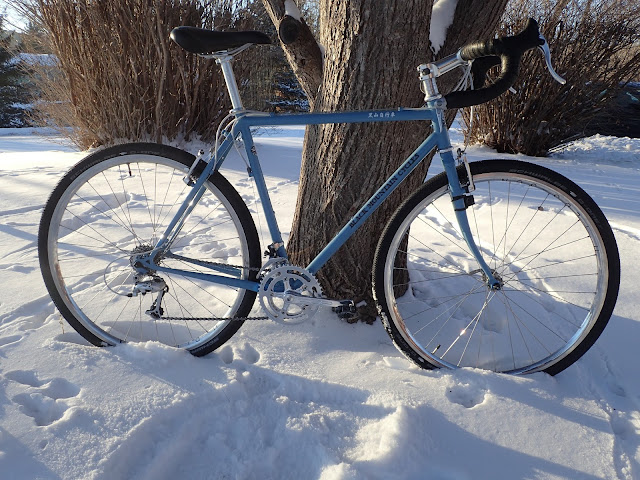
Mike Varley of Black Mountain Cycles designed a steel bicycle frame and fork that works wonders for long rides over rough roads. But that's not news. Not around here.
In early 2014, after a year of riding gravel on a zippy cyclocross bike, and more than a little research, I built up a Black Mountain Cycles "monster cross" frame and fork as a durable, dependable bike for long rides on remote gravel and dirt roads. It's the most comfortable road bike I've ever ridden.
My Black Mountain has faithfully carried me through memorable all-day-and-into-the-night races, such as Odin's Revenge, Almanzo Royal, Dirty Kanza and Gold Rush Mother Lode, as well as many shorter races, weekend explorations, Black Hills BackBone and DoubleBackBone reconnaissance rides and attempts, sub-24 hour and multi-day bike packing trips and daily commutes. I love it.
My Black Mountain after its 30 month/12,000 mile frame-off overhaul in late 2016.
I'm not alone. From his one-man shop, Mike Varley sends his bikes all over, even to the remote back roads of central Iowa. Mark Stevenson, aka Guitar Ted of Trans Iowa fame, has ridden an orange Black Mountain monster cross bike on Iowa gravel for years and regularly writes about it. As a result of Mark's reviews, many others apparently found their way to Black Mountain. To show his appreciation, Mike Varley is sponsoring Trans Iowa this year with a Black Mountain frame and fork to be awarded to the "grittiest rider." Black Mountain Blog - Trans Iowa. How sweet is that.
Now, it's all coming together for me. In April, I plan to journey to Trans Iowa as a volunteer. A Gravel Pilgrimage. Sometime after the event, I'll ride at least a few of those storied gravel and dirt miles around Grinnell on my Black Mountain. Something close to zero percent chance of not doing so.
So, it seems timely to post another unabashed endorsement of the Black Mountain Cycles "monster cross" bike as a rough road slayer. The steel frame with its relaxed geometry and clearance for up to 45 mm tires, paired with a compliant, sloping steel fork designed for rim brakes, create a comfortable, stable ride at speed for long rides on rough roads. Old school semi-horizontal drop outs allow a simple field conversion to single speed for those gravelly mud misadventures. Many other thoughtful features adorn this frame and fork. It's a well-conceived and well-executed bike suitable for all kinds of cycling. It's now the only road bike I own and it's just the right bike for how and where I ride.
For more detailed information about this bike, go directly to Mike Varley's words and pictures on his Black Mountain Cycles website. Black Mountain Cycles.
Addendum. For more details, here's a 2015 post on my rationale of choosing this frame and fork, as well as each component. An All Road Bike. Later I highlighted a nifty frame feature that allows an easy field conversion to single speed, a rarity these days. Make it Single Speed. Then after 30 months and about 12,000 miles of mostly rough roads, I overhauled everything and wrote a seven part series about it. It's Time, Frame and Fork, Wheels and Tires,Drivetrain,Brakes and Shifters,Controls,On the Road Again. I love my Black Mountain so much that I relinquished my beloved Torelli lugged steel cyclocross bike. Letting Go. Love this bike. I rode it on every ride that made it to this blog, so you'll find pictures all over.