Search This Blog

Showing posts with label Great Divide Mountain Bike Route. Show all posts

Monday, February 17, 2025

Cloud Peak 500 Page - 2025 Bump

The Cloud Peak 500. A unique ride through the Old West. And another great shake out ride for the Great Divide Mountain Bike Route.

In late 2019, compadre Lucas Haan alerted me to the Cloud Peak 500 bikepacking route in the Big Horn Mountains of Central Wyoming. I immediately recognized its potential as a primo shake out ride as part of my long running preparations to ride the Great Divide Mountain Bike Route. The Cloud Peak 500 offered about 20 percent of the distance and elevation gain of the Great Divide on a seemingly similar variety of remote roads and terrain, with occasional small towns for re-supply. As a bonus, the Big Horns are but a few hours from Rapid City. I marked it as a priority ride for 2020. 

Meanwhile, cycling friend Paul Brasby of North Platte, Nebraska caught wind of my Cloud Peak 500 plans. As a long time successful road racer, Paul was an enthusiastic gravel racer and bikepacker with both eyes fixed on riding the Great Divide. He also concluded that the Cloud Peak 500 looked to be an ideal ride to prepare for that, as well as a great ride on its own. We decided to start together and see how it goes. 

Dropping off Dude's Downhill on the Cloud Peak 500.
(photo by Paul Brasby)

Over seven long, hot days in August 2020, we rode the Cloud Peak 500 route, which was my longest, hardest, and overall biggest ride of that year. Although I stopped short of 500 miles, Paul rode on, through a gauntlet of challenges, to become the first, and still only, official finisher of the Cloud Peak 500 bikepacking race.

I then wrote a series of blog posts about our experience, primarily as a scrapbook for me and any friends that might enjoy it, but also as a resource for others who may be intrigued. Those Daily Ride reports describe our experience and the Logistics reports reveal much to help plan such a ride. 

Eventually, I compiled all those blog posts onto a single Page called Cloud Peak 500 Page (2020) that appears within a column of Pages on the right side of the Black Hills BackBone blog. If you're looking for a shake out ride to prepare for the Great Divide Mountain Bike Route, or just looking for a unique 500 mile bikepacking adventure in Central Wyoming, take a look at the Cloud Peak 500.


Thursday, January 30, 2025

What's The Difference - BackBone, DoubleBackBone & BackBone Grande

Folks regularly ask about the differences between my Black Hills BackBone, DoubleBackBone, and BackBone Grande routes. Here's an overview that describes the genesis, formation, and development of these three routes and how they differ. 

My introduction of the Black Hills BackBone Grande route in 2023 prompted many questions about the differences from my older Black Hills BackBone and DoubleBackBone routes. Fair enough. 

BackBone & DoubleBackBone = designed for long gravel rides, but can bikepack it. 
The BackBone Grande = designed for multi-day bikepacking, but can continuous ride it.

Of course, there's much more to that story. The BackBone Grande draws from a deeper data base built from 10 additional years of back roads exploration in the Black Hills and the unforgettable experiences of multi-day and multi-week bikepacking rides across the Mountain West. It takes cyclists to more memorable places, both well-known and obscure, on a wider variety of challenging roads. It's a different beast.

If you're looking for USFS Low Standard Roads, the Black Hills are full of them.
The Black Hills are beautiful. Most any combination of roads winding through the Black Hills will be a beautiful ride. But there is a difference between better and best. The BackBone Grande covers what I consider to be the very best of our Black Hills and surrounding prairie in a cross-state bikepacking ride.

USFS Secondary Road 189 southbound down Flag Mountain.
The signature image of the Black Hills BackBone.
Back in 2014, I created the BackBone as a solo, self-supported, light and fast gravel ride. At 310 miles and 19,700 feet of elevation gain, it certainly pushes the limits of a long, continuous ride for most cyclists. But with straight forward navigation, 200 miles of Primary Roads, and 35 miles of pavement, the BackBone rides relatively fast. Low Standard Roads, the rough ones that really take it out of you and take you further out there, account for just 7 miles, or about 2%, of the BackBone.

In 2017, I then created the DoubleBackBone as an opportunity to ride the BackBone southbound and then return to North Dakota on mostly different roads. The DoubleBackBone runs generally to the West of the BackBone, so it's even more remote, with less re-supply opportunities and less cell coverage.

The overall road makeup of the DoubleBackBone is much the same as the BackBone. At 330 miles and 17,900 feet of elevation gain, it similarly rides relatively fast, with straight forward navigation, 238 miles of Primary Roads, and 38 miles of pavement. Low Standard Roads are less than 16 miles, or about 6%, of the DoubleBackBone.

Mostly on well developed gravel roads, the BackBone and DoubleBackBone are certainly suitable for loaded touring, if that's your jam. That's just not why they were created. 

USFS Low Standard Road 383 northbound to Gillette Canyon.
The signature image of the Black Hills DoubleBackBone.
After bikepacking throughout the Black Hills and across the Mountain West the past several years, I decided to design a new route specifically for a Great Divide type of bikepacking experience. For me, that means 50-100 mile days on a loaded mountain bike over back roads with significant climbing, more navigational challenges, more miles of rougher roads, more little known and even abandoned roads, a mix of re-supply and sleeping options, more natural and human-made sightseeing, both well known and obscure, and a few fun Zero Day opportunities. A much different experience.

The BackBone Grande is my take on that type of bikepacking route, featuring many miles of rougher roads with popular sights and little known gems along the way. This route will take you to many places the BackBone and DoubleBackBone do not. Those that have ridden the Great Divide or my Black Hills Bounty routes will catch a similar vibe on the BackBone Grande.

Like the Great Divide, it's not all back country. For a short break during this relatively remote bikepacking ride, I added some pavement across the college town of Spearfish to pass both bike shops, an assortment of restaurant and re-supply options, and lodging, including the popular city campground. Likewise, I skirted Custer to provide easy access to that popular tourist town with similar amenities. From Custer and from Hill City, I also added optional, off-route, mostly paved loops to Mount Rushmore, Sylvan Lake, Needles Highway, and Iron Mountain Road for a scenic, more conventional tourist day. No sense rushing a vacation. In 2024, I added the Mount Rushmore Alternative route from Custer to Hill City for those not wanting a Zero Day. I also added a short bypass of the notorious Trail #1 in Custer State Park. All of these maps are available as RideWithGPS files at my BackBone Grande Collection.

Lame Johnny Road westbound into the Black Hills.
The signature image of the Black Hills BackBone Grande.
(image by Kevin Fox)
At a touring pace of 60-70 miles per day, a bikepacker will ride 6-7 days to complete the 421 mile BackBone Grande, plus another day for an optional Mount Rushmore loop. Some will certainly ride it faster. Others may even attempt to through-ride it, although I don't recommend it. This is one to soak in. Besides, who wants to T-bone a large mammal at night while settled in aerobars and staring bleary-eyed at a power meter.

The BackBone Grande is a remote, rough road route for self-sufficient, experienced bikepackers capable of successfully riding through sparsely populated backcountry with spotty, if any, cell coverage. You're on your own out there. Enjoy it.

USFS Low Standard Road 530.1A.
A piece of the 58 miles of Low Standard Roads on the BackBone Grande.
Here is an approximate breakdown of the roads on the BackBone, DoubleBackBone, and BackBone Grande. Perhaps the most simple comparison of these routes is the total miles of Low Standard roads. BackBone = 7 miles. DoubleBackBone = 16 miles. BackBone Grande = 87 miles. Another comparison adds the Low Standard and Secondary roads. Backbone = 75 miles. DoubleBackBone = 44 miles. BackBone Grande = 167 miles. The Grande is a different beast.

For a description of Primary, Secondary, and Low Standard roads in the Black Hills, go to my post. The Good, The Bad & The Ugly.

BackBone - 310 miles/19,700 feet gain (BackBone Map)
65% - Primary (200 miles)
22% - Secondary (68 miles)
11% - Paved (35 miles)
2% - Low Standard (7 miles)
0% - Single Track (0 miles)

DoubleBackBone - 330 miles/17,900 feet gain (DoubleBackBone Map)
72% - Primary (238 miles)
11% - Secondary (38 miles)
11% - Paved (38 miles)
6% - Low Standard (16 miles)
0% - Single Track (0 miles)

BackBone Grande - 421 miles/23,800 feet gain (BackBone Grande Map)
49% - Primary (205 miles)
19% - Secondary (80 miles) 
11% - Paved (48 miles)
21% - Low Standard (87 miles)
< 1% - Single Track (1 mile)

For more information on each route and links to posts with images, ride reports, and stories, go to the Black Hills BackBone and DoubleBackBone Page and the BackBone Grande Page. Happy trails.


Thursday, January 16, 2025

Black Hills BackBone Grande Page - 2025 Bump

My January 2023 post "Introducing A Bikepacking Route" generated more page views on this blog than any other, including my Great Divide Mountain Bike Route posts. Now, two years later, it still does. And folks from all over continue to discover this route and imagine riding it.

So, here's my annual post linking to the BackBone Grande Page, which describes the route in detail and links to posts sharing maps, images, logistics, and ride reports, including a series on the first through-ride by Paul Brasby and me in June 2023. Give that imagination a stir.
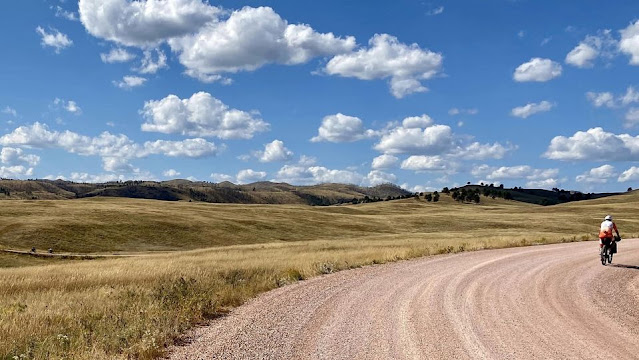
Streaming into the Black Hills from Custer State Park.
(image by Kevin Fox)
In 2014, I created a bicycle route that I called the Black Hills BackBone, which is a North-South cross-state ride of the State of the South Dakota on primarily gravel and dirt roads along the spine of the Black Hills. The Black Hills BackBone blog first published in 2015 to document the route and attempts to ride it. In 2017, I created the DoubleBackBone route as an opportunity to ride the BackBone route south and then turn north to return to the North Dakota border on mostly different roads. I designed these routes as solo, self-supported, continuous rides across the state, in the spirit of the original TransIowa, the Gut Check 212, and similar continuous cross-state races. See, Black Hills BackBone & DoubleBackBone Page.

Over the years since, I have ridden all those miles, and many more, in the Black Hills and surrounding prairie. I love exploring back roads unknown to me, creating interesting routes, and seeing routes created by others. If not riding, scouting, researching, or routing, I'm probably talking with someone about back country roads around here.
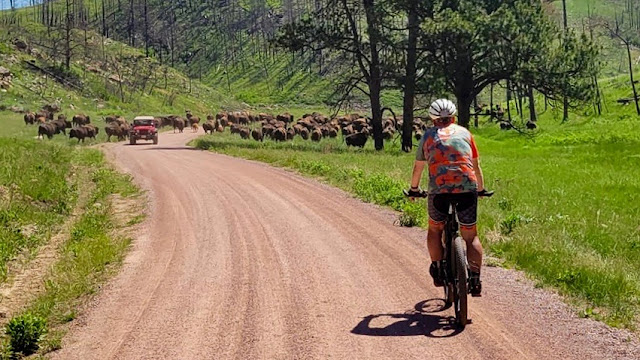
Traffic jam on Lame Johnny Road in Custer State Park.
(image by Paul Brasby)
I started bikepacking in earnest in 2019, rode the Cloud Peak 500 in the Big Horn Mountains of Wyoming in 2020, and then rode the Great Divide Mountain Bike Route across the country in 2021. Those longer bikepacking rides are extensively covered on my blog throughout 2020-2022. See, Cloud Peak 500 Page; Great Divide Mountain Bike Route Page. Inspired by those rides, I created many multi-day bikepacking routes in the Black Hills, including five different one week trips for out-of-state friends, several 2-3 day trips, and many overnighters.

After completing the Great Divide in 2021 and learning of the current development of the Western Wildlands Route and the Great Plains Gravel Route, I took another look at my BackBone and DoubleBackBone. I still love those routes for their intended purpose, but they were not created for bikepacking. The Black Hills deserve such a route.

Here's my take on it. The Black Hills BackBone Grande.

Mickelson Trail tunnel in the Central Black Hills.
(image by Paul Brasby)
As a starting point, I consider bikepacking to be much more than simply blasting across the countryside to see how fast one can possibly cover a distance. Rather, for me, it's backpacking on a bike, taking the time and effort to absorb the local scenery, history, culture, and wildlife. See, e.g., How I Would Bikepack The GDMBR (2019). As such, to create the BackBone Grande, I first identified what I consider the very best of our Black Hills and surrounding prairie and then connected things with a mix of unique, remote back roads. Here are some highlights:
  • Buffalo Gap National Grasslands, prairie with dispersed camping (miles 3-11; miles 32-77);
  • Wind Cave National Park and Custer State Park with buffalo and wild burros (miles 102-124);
  • Cathedral Spires views (miles 126-128);
  • Mickelson Trail rails-to-trails path out of Custer, with views of Crazy Horse Memorial (miles 134-144);
  • historic Gold Mountain Mine (mile 167);
  • back on the Mickelson Trail for two hard rock tunnels (miles 174-178); 
  • creek side Castle Peak Road (miles 180-191), passing USFS Castle Peak Campground (mile 187);
  • Black Fox Road (miles 202-207), passing USFS Black Fox Campground (mile 202);
  • northern portion of Spearfish Canyon and Roughlock Falls (mile 234);
  • Belle Fouche National Wildlife Refuge (miles 293-295);
  • the Geographic Center of the United States (mile 323);
  • the historic stage coach stop of Harding (mile 355);
  • Custer Gallatin National Forest near the North Dakota border (miles 396-411), especially Fuller Pass Road passing USFS Picnic Springs Campground (mile 402).

Abandoned road through Lost Canyon in the Northern Black Hills.
(image by Paul Brasby)

In general, the BackBone Grande is about 420 miles long and almost 24,000 feet of gain, with 90% on county gravel or Forest Service gravel/dirt roads. It's a fun mix of remote roads, similar to those on the Great Divide Mountain Bike Route, all suitable for experienced bikepackers on loaded bicycles having tires 2" wide or more. A bike designed for the Great Divide, such as the Salsa CutThroat or Fargo, would work well for many. Of course, I rode the route in 2023 on my Jones 29+ rigid mountain bike with 2.35 inch tires.

Full service towns with bike shops are Custer (mile 135) and Spearfish (mile 262). C-store/restaurant type re-supply opportunities are at Oelrichs (mile 46), Buffalo Gap (mile 95), Blue Bell (mile 124), Hill City (mile 162), Rochford (mile 195), Cheyenne Crossing (mile 227), Savoy (mile 233), St. Onge (mile 281), and Buffalo (mile 382).

For a Great Divide type Zero Day, I recommend Custer and/or Hill City for an off-day, off-route ride of a mostly paved loop featuring Mount Rushmore, Sylvan Lake, Needles Highway, and Iron Mountain Road (aka Pig Tail Highway). For a relaxing Zero Day in a college/mountain bike town, enjoy a day in Spearfish.


Fuller Pass Road through Custer Gallatin National Forest.
(image by Paul Brasby)

Fuller Pass Road through Custer Gallatin National Forest, just a few miles from North Dakota.
To create this route, I received valuable input from Lucas Haan of Black Hills Gravel and Paul Brasby of the Pony Express Bike-packing Adventure. To make this the very best it can be, Paul and I then rode the entire route in June of 2023, capturing images, taking notes, and making a few minor changes. In 2024, I also found an additional 30 miles of rugged two track through Buffalo Gap National Grasslands, bringing that section up to 45 memorable miles.

Barely marked roads in Buffalo Gap National Grasslands.

Immersed in the barely tracked Buffalo Gap National Grasslands.
(image by Paul Brasby)

Here's the link to the BackBone Grande route on RideWithGPS. BackBone Grande. Here's the link to the Mount Rushmore loop from Custer. BackBone Grande - Mt. Rushmore (Custer). Here's the link to the Mount Rushmore loop from Hill City. BackBone Grande - Mt. Rushmore (Hill City).

Note that the "Paved" surfaces data provided by RideWithGPS is wildly inaccurate, as it always is out here. The main route is about 90% county gravel or U.S. Forest Service gravel/dirt roads.
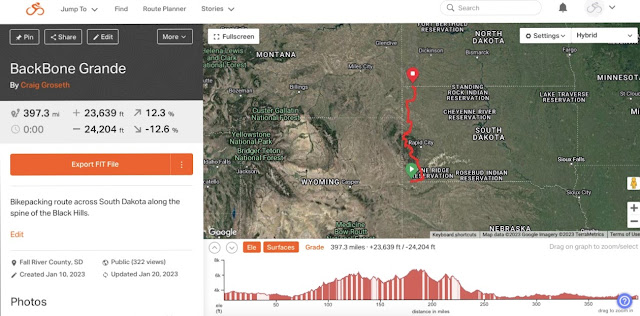
The Black Hills BackBone Grande.

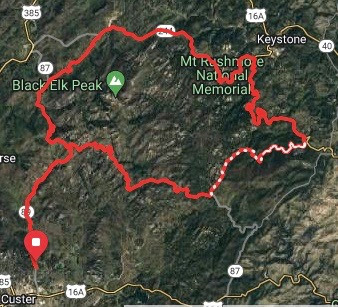
Optional off-route Mount Rushmore loop from Custer.
(46 miles/5,350 feet of gain)
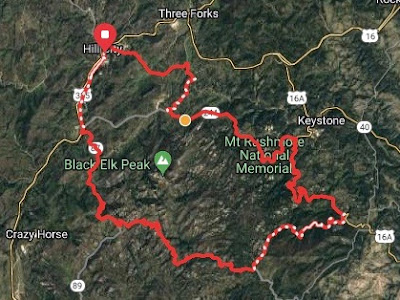
Optional off-route Mount Rushmore loop from Hill City.
(44 miles/4,900 feet of gain)
The Black Hills BackBone Grande. 

A great ride on its own, and a great shake out ride for something bigger, like the Great Divide Mountain Bike Route.

Sunday, May 19, 2024

GDMBR - Ride With Reinhart

A fair number of the folks who ask about my ride of the Great Divide Mountain Bike Route ("GDMBR") are considering their own. To start their preparation, I point to the maps and book by the Adventure Cycling Association, the creators of the route, and then to readily accessible journals and articles available on-line, including my 50+ blog posts. GDMBR Page. Also, a growing number of cyclists now document their experience by video.

In my relentless research before riding the GDMBR, I watched just about every YouTube video I could find. I even watched the 2010 movie "Ride The Divide" showcasing the Tour Divide, which is an informally organized "race" that piggybacks along most of ACA's GDMBR route. Some videos were professionally staged, edited, and produced, some were little more than a collection of phone videos, and many fell somewhere in between. I enjoyed them all and learned much.

Now three years removed from that ride preparation, I still enjoy watching new GDMBR videos as they come out. Not surprisingly, I learn something every time. Plus it's just fun to experience it anew, this time through the heart of a kindred spirit.

Of all the videos I've watched, a recent series stands out as the one to watch to prepare for a ride of the GDMBR. Ride With Reinhart - YouTube Channel

Reinhart toured the route over 53 days and posted a 10-20 minute long video for each day. So, the episode for any given day is not a long watch, but the series does take some time to work through. I watched 2-3 episodes at a sitting, occasionally going back for another look.

I found Reinhart to be engaging, informative, and entertaining. A guy I'd probably like to ride with. He includes a short summary of the previous day's ride, a description of the campsite or accommodations, and a look ahead. As one would expect, Reinhart carefully attends to weather, water, food, and shelter, but does not let logistics dominate. Each day, he includes significant video footage of the roads, scenery, and encounters with others, with at-the-time commentary. 

Each video looks like it presents an honest, unvarnished glimpse of that particular day on the route. Strung together, the series paints a comprehensive picture of the overall experience.

For someone preparing to ride the GDMBR, or for someone who wants to dive deeply into the day-to-day experience of riding the GDMBR, I recommend the Ride With Reinhart video series. I know that I'll watch it again. 

Ride With Reinhart - 2023 GDMBR Wrap Up


Sunday, February 11, 2024

BackBone Grande - Yes, Point-to-Point

Almost immediately after I published my 400 mile BackBone Grande bikepacking route last year, several people asked for a return route. Recently, the issue arose again. Really?

The short answer is no. A better answer is not yet. A more complete answer is that the BackBone Grande results from of years of riding remote gravel/dirt roads throughout the Black Hills, creating many routes for a variety of ride experiences, and receiving valuable feedback from seasoned cyclists. That process took some time. A return route, if any, deserves the same.

So, point-to-point it is, even with the logistical challenge of getting to the start and from the finish.

The Southern terminus of the BackBone Grande.
County gravel begins in just two miles at the practically abandoned town of Ardmore.

I designed the BackBone Grande to create an experience akin to the Great Divide Mountain Bike Route, which is a point-to-point route across the entire country. Most through-riders of the Great Divide somehow find a way to shuttle to the relatively remote start and from the even more remote finish. If that works for the 2,500 mile Great Divide, then it should work for the 400 mile BackBone Grande.

Also, nothing prohibits one from pedaling to the start from anywhere. In fact, many Great Divide through-riders start their ride from a more accessible location than the start of the route, like a relatively close town with public transportation. Same with returning home from the finish. I've read of riders taking Amtrak to Glacier National Park and then riding a couple of days to Roosville. From the finish, many simply ride to El Paso for public transportation home. On my 2021 Great Divide ride, I even met a couple riding north bound who started from their home in San Diego, rode to Antelope Wells, north to Roosville, and then back home to San Diego. Again, such logistics are much more simple on the much shorter BackBone Grande. 

The northern terminus of the BackBone Grande.
A multi-purposed sign sits at the unmarked border of North Dakota.

An occasional Great Divide through-rider will even turn around at the finish and ride back to the start. The vast range of weather conditions over those 2,500 miles, times two, limit start/finish options for such an endeavor. However, at 50 miles or so per day, a touring cyclist could successfully complete such a yo-yo ride by riding northbound during June and July and then southbound during August and September. So, it's possible.

The much shorter BackBone Grande offers a wider weather window and many more options for start/finish locations and times. Indeed, the start/finish need not even be at one of the state borders. For example, one could start at the very accessible town of Hill City in the heart of the Black Hills, ride the BackBone Grande route to one end, turn around to ride the entire route to the other end, and then ride back to Hill City. 

That actually sounds fun.

Perhaps a return route worthy of the BackBone Grande may be in the future. For now, enjoy that beautiful point-to-point.


Sunday, February 4, 2024

Cloud Peak 500 Page - 2024 Bump

The Cloud Peak 500. A unique ride through the Old West. And a great shake out ride for the Great Divide Mountain Bike Route.

In late 2019, compadre Lucas Haan alerted me to the Cloud Peak 500 bikepacking route in the Big Horn Mountains of Central Wyoming. I immediately recognized its potential as a primo shake out ride as part of my long running preparations to ride the Great Divide Mountain Bike Route. The Cloud Peak 500 offered about 20 percent of the distance and elevation gain of the Great Divide on a seemingly similar variety of remote roads and terrain, with occasional small towns for re-supply. As a bonus, the Big Horns are but a few hours from Rapid City. I marked it as a priority ride for 2020. 

Meanwhile, cycling friend Paul Brasby of North Platte, Nebraska caught wind of my Cloud Peak 500 plans. As a lifetime, successful road racer, Paul is an enthusiastic gravel racer and bikepacker with both eyes fixed on riding the Great Divide. He also concluded that the Cloud Peak 500 looks to be an ideal ride to prepare for that, as well as a great ride on its own. We decided to start together and see how it goes. 

Dropping off Dude's Downhill on the Cloud Peak 500.
(image by Paul Brasby)

Over seven long, hot days in August, we rode the Cloud Peak 500 route, which was my longest, hardest, and overall biggest ride of 2020. Although I stopped short of 500 miles, Paul rode on, through a gauntlet of challenges, to become the first, and still only, official finisher of the Cloud Peak 500 bikepacking race.

I then wrote a series of blog posts about our experience, primarily as a scrapbook for me and any friends that might enjoy it, but also as a resource for others who may be intrigued. Those Daily Ride reports describe our experience and the Logistics reports reveal much to help plan such a ride. 

Eventually, I compiled all those blog posts onto a single Page called Cloud Peak 500 Page (2020) that appears within a column of Pages on the right side of the Black Hills BackBone blog. If you're looking for a shake out ride to prepare for the Great Divide Mountain Bike Route, or just looking for a unique 500 mile bikepacking adventure in Central Wyoming, take a look at the Cloud Peak 500. 


Sunday, January 28, 2024

Great Divide Mountain Bike Route Page - 2024 Bump

Spent the last year Rocky Mountain way,
Couldn't get much higher,
Out to pasture, think it's safe to say,
Time to open fire.

Rocky Mountain Way, Joey Vitale, Joe Walsh, Ken Passarelli & Rocke Grave (1973).

Out there, on the Great Divide Mountain Bike Route.
(image by Paul Brasby)

In late summer 2021, I rode the Great Divide Mountain Bike Route self-supported from the Canadian border at Roosville, Montana to the Mexican border at Antelope Wells, New Mexico. It was an amazing, unforgettable experience. I'll always cherish that overwhelming feeling of pure joy and utter disbelief at the finish. That is why to dream audaciously, set goals boldly, and work relentlessly to achieve.

After riding 7 weeks on the Great Divide, I spent the next 7 months writing about it. Over the Fall and Winter of 2021, and well into the Spring of 2022, I published 50 blog posts about my experience. Stories of individual happenings or days flowed easily, but expressing the overall experience proved difficult. I know that I still have not adequately covered it. 

Nonetheless, to this day, I still see traffic on many of these posts. Now, with the New Year, I know that folks are preparing for their own ride of the Great Divide this summer and are looking for information and encouragement. So, I'm bumping a post from last year when I made those Great Divide posts easier to find by creating a separate Page just for them.

On the right side of the main Black Hills BackBone blog, look for the section called "Pages." There is one called "Great Divide Mountain Bike Route (2021)." On that Page, you will find links to my Great Divide blog posts on a variety of subjects, including preparations, gear lists, packing, bike set-up, logistics, navigation, food, encounters with others, adaptations, and the all important mental aspect. Photographs adorn each post. There's even a slide show with one representative image for each day and an entire Gallery of amazing Paul Brasby images. 

If you plan to ride the Great Divide, or you just want to read along with my ride, it's a place to start.

Rocky Mountain Way, Joe Walsh (1973).

Rocky Mountain Way, Joe Walsh (live at Santa Monica Civic Auditorium 1976).

Sunday, January 7, 2024

BackBone Grande Page - 2024 Bump

The Black Hills BackBone Grande. A bikepacking route across the State of South Dakota along the spine of the Black Hills. Designed specifically for bikepacking to showcase the best of our Black Hills. 

Here's a link to the BackBone Grande Page, which describes the route in detail and links a series of posts sharing maps, images, logistics, and ride reports. 

Streaming into the Black Hills from Custer State Park.
(image by Kevin Fox)
In 2014, I created a bicycle route that I called the Black Hills BackBone, which is a North-South cross-state ride of the State of the South Dakota on primarily gravel and dirt roads along the spine of the Black Hills. The Black Hills BackBone blog first published in 2015 to document the route and attempts to ride it. In 2017, I created the DoubleBackBone route as an opportunity to ride the BackBone route south and then turn north to return to the North Dakota border on mostly different roads. I designed these routes as solo, self-supported, continuous rides across the state, in the spirit of the original TransIowa, the Gut Check 212, and similar continuous cross-state races. See, Black Hills BackBone & DoubleBackBone Page.

Over the years since, I have ridden all those miles, and many more, in the Black Hills and surrounding prairie. I love exploring back roads unknown to me, creating interesting routes, and seeing routes created by others. If not riding, scouting, researching, or routing, I'm probably talking with someone about back country roads around here.

Traffic jam on Lame Johnny Road in Custer State Park.
(image by Paul Brasby)
I started bikepacking in earnest in 2019, rode the Cloud Peak 500 in the Big Horn Mountains of Wyoming in 2020, and then rode the Great Divide Mountain Bike Route across the country in 2021. Those longer bikepacking rides are extensively covered on my blog throughout 2020-2022. See, Cloud Peak 500 Reports & Logistics Page; Great Divide Mountain Bike Route Page. Inspired by those rides, I created many multi-day bikepacking routes in the Black Hills, including four different one week trips for out-of-state friends, several 2-3 day trips, and more overnighters.

After completing the Great Divide in 2021 and learning of the current development of the Western Wildlands Route and the Great Plains Gravel Route, I took another look at my BackBone and DoubleBackBone. I still love those routes for their intended purpose, but they were not created for bikepacking. The Black Hills deserve such a route.

Here's my take on it. The Black Hills BackBone Grande.

Mickelson Trail tunnel in the Central Black Hills.
(image by Paul Brasby)
As a starting point, I consider bikepacking to be much more than simply blasting across the countryside to see how fast one can possibly cover a distance. Rather, for me, it's backpacking on a bike, taking the time and effort to absorb the local scenery, history, culture, and wildlife. See, e.g., How I Would Bikepack The GDMBR (2019). As such, to create the BackBone Grande, I first identified what I consider the very best of our Black Hills and surrounding prairie and then connected things with a mix of unique, remote back roads. Here are some highlights:
  • Buffalo Gap National Grasslands, prairie with dispersed camping (miles 3-11; miles 33-44);
  • Wind Cave National Park and Custer State Park with buffalo and wild burros (miles 80-102);
  • Cathedral Spires views (miles 106-108);
  • Mickelson Trail rails-to-trails path out of Custer, with views of Crazy Horse Memorial (miles 114-124);
  • historic Gold Mountain Mine (mile 146);
  • back on the Mickelson Trail for two hard rock tunnels (miles 153-157); 
  • creek side Castle Peak Road (miles 159-170), passing USFS Castle Peak Campground (mile 167);
  • Black Fox Road (miles 181-186), passing USFS Black Fox Campground (mile 181);
  • Roughlock Falls (mile 213);
  • Belle Fouche National Wildlife Refuge (miles 272-275);
  • the Geographic Center of the United States (mile 302);
  • the historic stage coach stop of Harding (mile 334);
  • Custer Gallatin National Forest near the North Dakota border (miles 381-396), especially Fuller Pass Road passing USFS Picnic Springs Campground (mile 387).
Sale Barn Road outside of St. Onge.
(image by Craig Groseth)
In general, the BackBone Grande is about 400 miles long, with 23,500 feet of gain and 90% on county gravel or Forest Service gravel/dirt roads. It's a fun mix of remote roads, similar to those on the Great Divide Mountain Bike Route, all suitable for experienced bikepackers on loaded bicycles having tires 2" wide or more. A bike designed for the Great Divide, such as the Salsa CutThroat or Fargo, would work well for many. Of course, I rode the route in 2023 on my Jones 29+ rigid mountain bike with 2.35 tires.

Full service towns with bike shops are Custer (mile 114) and Spearfish (mile 241). C-store/restaurant type re-supply opportunities are at Oelrichs (mile 48), Buffalo Gap (mile 74), Blue Bell (mile 102), Hill City (mile 141), Rochford (mile 174), Cheyenne Crossing (mile 206), Savoy (mile 212), St. Onge (mile 260), and Buffalo (mile 361).

For a Great Divide type Zero Day, I recommend Custer and/or Hill City for an off-day, off-route ride of a mostly paved loop featuring Mount Rushmore, Sylvan Lake, Needles Highway, and Iron Mountain Road (aka Pig Tail Highway). For a relaxing Zero Day in a college/mountain bike town, enjoy a day in Spearfish.

Fuller Pass Road through Custer Gallatin National Forest, just a few miles from North Dakota.
To create this route, I received valuable input from Lucas Haan of Black Hills Gravel and Paul Brasby of the Pony Express Bike-packing Adventure. To make this the very best it can be, Paul and I then rode the entire route in June of 2023, capturing images, taking notes, and making a few minor changes. It's ready.

Here's the link to the BackBone Grande route on RideWithGPS. BackBone Grande. Here's the link to the Mount Rushmore loop from Custer. BackBone Grande - Mt. Rushmore (Custer). Here's the link to the Mount Rushmore loop from Hill City. BackBone Grande - Mt. Rushmore (Hill City).

Note that the "Paved" surfaces data provided by RideWithGPS is wildly inaccurate, as it always is out here. The main route is about 90% county gravel or U.S. Forest Service gravel/dirt roads.

The Black Hills BackBone Grande.

Optional off-route Mount Rushmore loop from Custer.
(46 miles/5,350 feet of gain)
Optional off-route Mount Rushmore loop from Hill City.
(44 miles/4,900 feet of gain)
The Black Hills BackBone Grande. 

A great ride on its own, and a great shake out ride for something bigger, like the Great Divide Mountain Bike Route.


Sunday, September 3, 2023

Time To Re-Tire

Cyclists always ask about tires. Here's a short story of a tire that worked great for my bikepacking.

For over 3 years, I tested the capabilities and components of my Jones 29+ mountain bike in all sorts of conditions, including loaded tours on single track and rough roads. I scrutinized every bit and piece, but maybe wheels and tires more than anything. My original wheel set ran behemoth 3.25 inch tires on 45 mm rims, which worked great on technical tracks, but rode sluggish on decent gravel and dirt. Ultimately, I bought a narrower, lighter wheel set to run narrower, lighter tires for bike packing all but the roughest stuff. See, Next Time on the Jones 29+ (March 2021).

In early July 2021, I finally selected and installed a new set of tires for my impending ride of the Great Divide Mountain Bike Route. The 2.60 inch Bontrager XR2 Team Issue tire, for both front and rear.

What a great tire for that purpose.


On a fully loaded bike on rough roads, that front tire rolled every one of my 2,650 miles from Canada to Mexico without a single issue, without a single crash. The back tire took a puncture at about Mile 80 on Day 2 and the plug held for over 1,500 miles. I may have been able to baby it to the border, but decided to replace it in Salida, Colorado before launching into the rocky remotes of New Mexico. 

I then rode all of 2022 on that same 2.60 XR2 Team Issue front tire, including the 5 day 2022 Black Hills Bounty bike packing tour. I even rode it through the winter and the first half of 2023, fully loaded to prepare for bikepacking rides this summer. All with no leaks, no flats, and no issues.

That's a lot of long, hard miles carrying a loaded bike on rough roads and trails. In addition to being durable, the XR2 Team Issue rolled well, gripped great, and tracked flawlessly. I loved its performance over a long period of time in a wide variety of conditions, especially loaded. The tire, like the bike, never limited where I could ride. 

Finally, just before our 2023 ride of the BackBone Grande in June, I removed that front tire. In its place, I installed slighter narrower 2.35 inch XR2 Team Issue tires, both front and rear. 

I suspect I'll love those tires, too.

Well deserved retirement, although here it looks like it's got some life left.

July 2021 trail test of brand new 2.60 Bontrager XR2 Team Issue tires on M-Hill,
just days before my 2021 ride of the Great Divide.


Sunday, August 27, 2023

BackBone Grande - Invitation & Offer

The BackBone Grande is a unique 400 mile bikepacking route across the State of South Dakota along the spine of the Black Hills. I designed this route specifically for a Great Divide type of bikepacking experience that showcases the best of our Black Hills and surrounding prairie. For a series of posts introducing the route, including a link to a digital map, and a series of posts of the first through-ride, go to the BackBone Grande Page

If you have any questions, ask. If you're thinking of venturing out there, let me know. I'm happy to help.

To kick start things a bit, here's an offer: Ride the BackBone Grande, any or all of it, and send me a story and pictures. I'll send you a BackBone Grande sticker. 

As others have noted, it doesn't say "Black Hills," or anything about bikepacking, or even cycling. 

Nope. If you know, you know.

Here's the sticker.

Here's the sticker in the wild.

Even in a crowd, the BackBone Grande sticker stands out.


Sunday, August 20, 2023

BackBone Grande - Photo Gallery

In June 2023, Paul Brasby and I rode the length of the BackBone Grande, my new 400 mile bikepacking route across the State of South Dakota along the spine of the Black Hills. For links to all my blog posts on the BackBone Grande and a RideWithGPS map, go to the BackBone Grande Page

We approached the first through-ride essentially as a final recon to confirm and document the route. Among other things, Paul captured hundreds of fantastic images along the way. He publicly shared many on his daily social media posts and I posted some on my blog.

Paul just took so many great images. To tell the overall story of the BackBone Grande visually, I chose five of them for each day of our ride and collected them here in one gallery. Scroll through for a glimpse of this journey through Paul's lens.

DAY 1 (NE Border to Oelrichs)

Ardmore Road.

Buffalo Gap National Grasslands Road 7026.

Buffalo Gap National Grasslands Road 7026.

Buffalo Gap National Grasslands Road 7022.

Buffalo Gap National Grasslands Road 7022.

DAY 2 (Oelrichs to French Creek Horse Camp)

Oak Draw Road (CSP 3).

Lame Johnny Road (CSP 4).

Fisherman Flats Road (CSP 2).

Trail #1.

Trail #1.

DAY 3 (French Creek Horse Camp to Hill City)

French Creek Horse Camp.

Unnumbered, unnamed single track connector to Hazelrodt Picnic Area.

USFS Low Standard Road 341.

USFS Low Standard Road 341.

Reno Gulch Road (USFS Secondary Road 303).

DAY 4 (Hill City to Rochford)

Mickelson Trail.

USFS Low Standard Road 389.1F.

USFS Low Standard Road 389.1D.

Mickelson Trail.

Castle Peak Road (USFS Low Standard Road 181).

DAY 5 (Rochford to USFS Timon Campground)

South Rapid Creek Road (USFS Primary 231).

Black Fox Camp Road (USFS Secondary Road 233).

USFS Low Standard Road 189.

USFS Low Standard Road 631.2.

Roughlock Falls Road (USFS Secondary Road 222).

DAY 6 (USFS Timon Campground to Spearfish)

Roughlock Falls Road (USFS Secondary Road 222).

Unnumbered, unnamed connector to Old Baldy Road (USFS Low Standard 633.1).

Unnumbered, unnamed connector to Old Baldy Road (USFS Low Standard 633.1).

Unnumbered, unnamed connector to Old Baldy Road (USFS Low Standard 633.1).

USFS Low Standard Road 130.

DAY 7 (Spearfish to Battle Creek Wetlands Project)

Lookout Mountain Road.

Lookout Mountain Road.

196th Street.

Crooked Oaks Road.

Old U.S. Highway 85.

DAY 8 (Battle Creek Wetlands Project to Buffalo)

Harding Road (County Road 897).

Harding Road (County Road 897).

Gilbert Road.

Gilbert Road.

Gilbert Road.

DAY 9 (Buffalo to ND Border)

Old U.S. Highway 85.

Brown-Johnson Road.

South Cave Road.

USFS Low Standard Road 3120.

USFS Low Standard Road 3123.

USFS Low Standard Road 3123.


THANK YOU PAUL!

Paul Brasby with Craig Groseth at the end of the first through-ride of the BackBone Grande.