Search This Blog

Sunday, November 13, 2022

2022 Black Hills Bounty - Southern Hills, Take Five

We'll Take Five days,
For the Bounty, no sweat,
So no lyrics today,
It's the Dave Brubeck Quartet.
Listen at the end to Take Five, Dave Brubeck Quartet, Live in Belgium (1964)

Scouting a rolling Low Standard Road for the 2022 Black Hills Bounty.

In 2021, at the request of my friend Paul Brasby, I created a 5 day bikepacking ride in the Central Black Hills of South Dakota for him and some out-of-state friends. I called it the "Black Hills Bounty" due to the treasure trove of remote, rough back roads through one-of-a-kind scenery. That route hit what I believe are some of the very best bikepacking roads in the Black Hills. We rode it in June of 2021, calling a few audibles and taking a few detours along the way. It turned out great because the guys riding it were great. 2021 Black Hills Bounty.

So, when they emphatically ask to return in 2022 for more, I'm not quite sure how to put together a sequel. Eventually, I decide to approach the ride as a glimpse of what it's like to ride the Great Divide Mountain Bike Route. Think of it as Bikepacking 202 directed toward the experienced cyclist, but moderately experienced bikepacker. I'll create a remote, rough road route that requires a variety of bikepacking skills, including finding and filtering water, preparing most meals, choosing dispersed and developed campsites, re-supplying from the occasional C-store, navigating poorly marked and unmarked roads, and re-charging devices. With very spotty cell coverage out there, I'll use a Spot Tracker to track our ride and communicate with my wife. Maybe we can take self-supported mindsets to a higher level.

To allow time and energy for all this, I significantly decrease mileage and elevation gain to about 40 miles and 3,000 feet of gain per day. Of course, I'll look for a Bounty mix of fast, medium and slow gravel, fast, medium and slow dirt, limited pavement, and probably some simple single track. For those wanting to explore more after setting up camp, I'll have maps and ideas for additional miles.

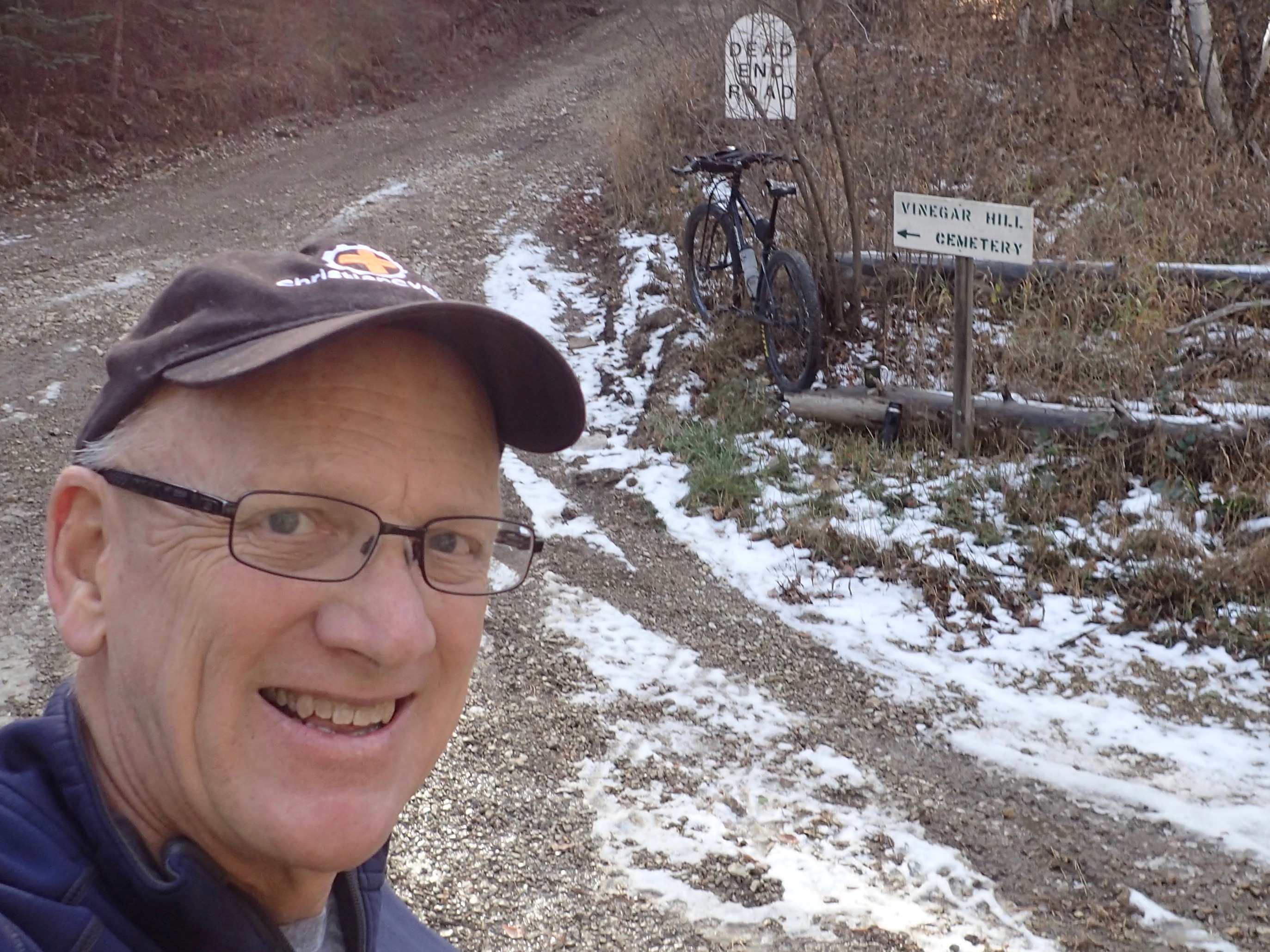
We're off to scout the Bounty. Just follow the snowy white road.

With that approach, I set out to create the 2022 Black Hills Bounty. Over time, after scouring many maps and scouting many miles, I decide to again start in Custer, but ride south and west into the Southern Black Hills that transition from forest to prairie. Few cyclists venture down there into the labyrinth of Forest Service Low Standard roads that don't always follow the federally documented maps. For example, some that map as spurs connect and some that connect do not. Tread on the trail is how to sort it out.

It's not a simple task. A host of Low Standard roads randomly shoot up and down hillsides and creep along canyons. Many are unmarked and, even if marked, simply dissipate into the forest after a spell. It's a spider web of tantalizing trails. Which to take? What combination? How to piece them together?

Further to the south, the number and variety of public roads diminish rapidly as private ranch land replaces National Forest. Well before reaching the town of Edgemont, the USFS Low Standard and Secondary roads are gone and only a handful of county gravel roads remain. But those roads are scenic and fun to ride. So, I keep at it. With some careful scouting, good fortune, and intel from a friendly rancher, I finally make it work by finding an abandoned Low Standard road that crosses a ridge to close a challenging gap between marked roads. See, Connecting.

The Black Hills are rich with a variety of USFS Low Standard Roads.

So, I had a plan for the 2022 Black Hills Bounty. It all added up to 5 days covering 202 miles and 15,447 feet of elevation gain, which averages about 40 miles and 3,100 feet of gain per day. With a bonus day six.

So, here's a breakdown of the daily plan. But it was just a plan. The riders will make or break the ride.


Day 1 (42 miles/3,073 feet gain)/7 miles Low Standard/3 Secondary/15 Primary/17 paved.
Mixed bag right from the start. Paved to access Low Standard climb, to Primary to access single track,
more Primary to access another rough, barely Low Standard, then rolling Primary and paved finish
to Wind Cave National Park. Water at mile 23 and at camp. No re-supply.


Day 2 (41 miles/3,948 feet gain)/10 miles Low Standard/11 Secondary/10 Primary/10 paved.
Twisty 10 mile paved start in Wind Cave National Park, middle 21 mile mix of Primary & Secondary,
with a rough climb on a 10 mile Low Standard to dry disperse camp.
Water & limited re-supply at Pringle (mile 29).
(photo by Kevin Fox)


Day 3 (38 miles/1,666 feet gain)/3 miles Low Standard/7 Secondary/26 Primary/2 paved.
Active recovery day. Initial Low Standard from dispersed dry camp, then hard, fast Primary
to Edgemont to camp at city campground. Water, power, showers, 2 C-stores, bar/grill.


Day 4 (40 miles/2,859 feet gain)/3 miles Low Standard/0 Secondary/34 Primary/3 paved.
Steady climbing on hard, fast (if dry) Primary roads, ending with rough Low Standard road.
Spring water near dispersed campsite. No re-supply.
(photo by Lane Bergen)


Day 5 (41 miles/3,901 feet gain)/20 miles Low Standard/0 Secondary/17 Primary/4 paved.
Finish with a flourish. 20 miles of primo Low Standard right from camp, then a short Primary climb
with Crazy Horse views and downhill Primary to Custer. Surface water at mile 16.


Bonus Day 6 (46 miles/5,347 feet gain)/2 miles Low Standard/4 Secondary/3 Primary/37 paved.
Unloaded optional day, mostly paved with some twists from 2021 (also 10 miles/1,000 feet gain less).
Climb Sylvan Lake Road, descend Needles Highway, Iron Creek single track connector
to climb Iron Mountain Road, lunch at Mt. Rushmore, Palmer Creek gravel to climb Sylvan Lake Road
and then drop to Custer. This day's ride is worth the trip, all by itself.
(photo by Paul Brasby)


Take Five, Dave Brubeck Quartet (1964)


Tuesday, November 8, 2022

2022 Coffeeneuring Challenge - Feeling Groovy

Slow down, you move too fast,
You've got to make the morning last,
Just kicking down the cobblestones,
Looking for fun and feeling groovy.
The 59th Street Bridge Song, Paul Simon (1966)


After a year hiatus, I'm back with the Coffeeneuring Challenge. And, unlike our #CoffeeOutside - Rapid City gatherings, this doesn't require setting a specific time and place and it doesn't mean sitting outside early mornings, unless, of course, that's what you want to do.

From her website ChasingMailboxes.com, endurance athlete Mary Gersema describes the concept:  "The Coffeeneuring Challenge is a time to mellow out, slow down the pedal strokes, and make the most of a delicious time of year by lingering over a cup of your favorite fall beverage. This challenge offers an opportunity to connect virtually or in-person with others, and can also be a time to carve out space for solitary contemplation over a beverage. Let's coffeeneur our way through the changing seasons."

"The Challenge is essentially as follows:
  • between October 7 through November 20, 2022
  • ride your bike to 7 different places
  • at least 2 miles round trip each time
  • drink 7 cups of coffee (or another fall-type beverage) and
  • document your coffeeneuring (either photos, Strava tracks, journal entries, control card, etc.)"
More information at Coffeeneuring Challenge 2022.

I don't need much of an excuse to ride a bike or drink coffee, but it's a fun twist. This challenge took me all around Rapid City, with nice, long stops at places I normally ride by, such as the Memorial Park Band Shell, Rushmore Lions Nature Park, Wilderness Park, Jackson Park Disc Golf Course shelter, the Nehemiah Memorial Slack Line & Balance Park, Founders Park, School of Mines Campus Quadrangle, and Kiwanis-Mary Hall Park. I even stopped for coffee on an unnamed U.S. Forest Service Road while scouting Black Hills Bounty routes.

To submit the requested documentation to complete the 2022 Coffeeneuring Challenge, I am Craig Groseth of Rapid City, South Dakota, USA. Below are my completed control cards and pictures of my rides, all of which are in the "Coffee Without Walls" category. I also completed the digital form linked on your website. Thank you, Mary, for creating and nurturing this community of Coffeeneurs.

#1. Memorial Park Band Shell, 10/8/22

#2. Rushmore Lions Nature Park, 10/10/22.

#3. Wilderness Park, 10/20/22.

#4. Jackson Park Disc Golf Course Shelter, 10/22/22.

#5. U.S. Forest Service Low Standard Road 172.1M,  Black Hills National Forest, 10/28/22.

#6. Nehemiah Memorial Slack Line & Balance Park, 10/30/22.

#7. Founders Park Shelter, with Lucas Haan and Lori Litzen, 11/5/22.

#8 (bonus). School of Mines Campus Quadrangle, 11/7/22.

#9 (bonus). Kiwanis-Mary Hall Park, 11/8/22.

Completed 2022 Coffeeneuring Challenge Card.


The 59th Street Bridge Song, Simon & Garfunkel, 
Smothers Brothers Comedy Hour (1967).


Monday, October 31, 2022

Long Memories In Small Towns

Bring a song and a smile for the banjo,
Better get while the gettin's good,
Hitch a ride to the end of the highway,
Where the neon turns to wood.

C'mon the risin' wind,
We're goin' up around the bend,
Oooh!
Up Around The Bend, John Fogerty (1970).

Mrs. Joyce Rathje, 92 years young, recently retired school teacher at Rising City, Nebraska.

Admittedly, I've been a Point A to Point B traveler for so long that it's my default mindset. What's the fastest, most direct route to drive to my destination? Got to be efficient. Got to get there. Things to do. People to see. Let's go. Time is short.

Since pedaling across the country on the back roads of the Great Divide Mountain Bike Route (See, 2021 GDMBR), however, I find myself more often taking local roads, slow rolling through small towns, checking out city parks, and even stopping for a meal at a local cafe. It's always worth it.

Sometimes, the back road route creates a highlight of the trip. Even a drive to a back road bike ride.

Memorial marking the Rising City K-12 school, long since removed.
The auditorium in the background is still used by the multi-town school district.

Earlier this fall, I fashioned a road trip that included a long weekend in Marysville, Kansas for the Pony Express 2 Day Bikepacking Adventure. See, 2022 Pony Express Bikepack. Starting the Kansas portion of the trip from Eastern South Dakota, I consider several routes to drive the remaining 250-ish miles. I decide to venture south of Yankton on U.S. Highway 81, at least until it turns westward. Then I'll take a few local roads 40-50 miles east and south to eventually connect with U.S. Highway 77 just outside Lincoln. It seems like a reasonably direct route on a nice mix of roads.

A few hours down the road, after neglecting to get gas in Columbus, I find myself looking to refuel in the midst of little but corn fields. Finally, a few buildings appear along the road, one of which is a gas station. Hey, it's actually a small town called Rising City, Nebraska, population 413. Well over 40 years ago, my wife's oldest brother married a girl from Rising City. Maybe I'll surprise her with a picture of her old school.

While at the gas pump, I notice the car next to me sports Nebraska license plates. Since my Great Divide ride, striking up random conversations with complete strangers is now second nature. So I ask the lady there if she knows where I can find the Rising City school, so I can take a picture for my sister-in-law. 

The lady politely asks, "She grew up here? What's her name?" 

"Dulcie." 

"Dulcie Gross. I was her kindergarten teacher. I'm Mrs. Rathje."

I stood in disbelief. How does this nice old lady remember a student from her kindergarten class 60 years ago? Mrs. Rathje simply goes on, noting Dulcie's musical talent and quiet nature. Amazing.

Mrs. Rathje then adds that the old school was torn down years ago when Rising City joined a multi-town school district, although the old gymnasium still is used. She also said she wasn't about to tell me where Dulcie lived, because that house has fallen into such disrepair that it would "break her heart." 

She says she's sorry, but she must be going. At 92 years young, still driving her car and living in her house, she leaves to care for a couple of her great grandkids. Amazing. If not for her family commitments, I think she'd hop on a bike for a tour around town.

The entrance to the Rising City school gymnasium.

A few weeks later, I tell Dulcie of my encounter with Mrs. Rathje and show her these pictures. Of course, she remembers her former teacher and joyfully talks of growing up in her hometown. Dulcie is not a bit surprised by Mrs. Rathje's overall spryness and vivid memory. Besides, says Dulcie, "Small towns have long memories sometimes."

This traveler will certainly remember this stop in a small town along a back road.


Up Around The Bend, Credence Clearwater Revival (1970).


Friday, October 28, 2022

The Power Of One

You don't need money, don't take fame,
Don't need no credit card to ride this train,
It's strong and it's sudden and it's cruel sometimes,
But it might just save your life,
That's the power of love, that's the power of love.
The Power of Love, Huey Lewis, Chris Hayes, Johnny Colla (1985).

On Day 2 of his 2020 Cloud Peak 500, Paul Brasby joyfully crests the climb up Hunt Mountain.
He remains the course record holder of that 500 mile bikepacking race
in the Big Horn Mountains of Wyoming.

Now finishing its ninth year, the Pony Express 120 Gravel Dash is a fixture on the Northern Kansas gravel cycling scene for its signature 120 mile race, its more accessible 75 mile and 30 mile routes, relay races, and a 2 day bikepacking adventure. Mark and Renee Hoffman of Backroads Bicycle, along with the City of Marysville, the Black Squirrel Cycling League, and a host of dedicated volunteers, put together a festival with something for everyone. This year, over 330 cyclists signed up for a taste of the Pony Express gravel experience.

It all started with one person.

In 2020, Paul Brasby leads out the inaugural Pony Express 120 Gravel Dash Bikepacking Adventure.
(photo by Black Squirrel Cycling League)

Paul Brasby is an engineer for the Union Pacific Railroad based out of North Platte, Nebraska. Over the years, his work has regularly taken him to the railroad town of Marysville, Kansas, with scheduled layovers there of 12 hours and often longer. An avid cyclist, Paul eventually left a bicycle in Marysville to ride during such layovers and soon discovered a vast network of unique gravel and dirt roads radiating deep into the surrounding countryside. There seemingly was no end to scenic, challenging roads in every direction.

About this time, Paul and his cycling buddies discovered the burgeoning gravel road racing scene and raced the inaugural, now legendary, Odin's Revenge in 2012. Smitten by the gravel bug, Paul then competed in many other races, enjoying a wide range of experiences resulting from the free wheeling, independent spirit of race directors and riders. Inspired by those grass roots races, he decided to share the wealth of his knowledge of great back roads by creating his own race.

Recognizing the potential for amazing gravel race routes from Marysville, Paul approached Brenda Staggenborg of the Marysville Chamber of Commerce for maps of local roads and for leads to appropriate locals for help organizing a gravel race. To Paul's surprise, the Chamber itself decided to join Paul to create the Pony Express 120 Gravel Dash. In the fall of 2014, they readily filled their field limit of 75. Five years later, with rider numbers approaching 200, Paul decided to turn the entire event over to a new, growing group of local gravel enthusiasts known as the Black Squirrel Cycling League. Before leaving, however, Paul initiated the first Pony Express 2 Day Bikepacking Adventure, the latest addition to the expanding Pony Express experience. See2022 Pony Express Bikepack and 2020 Pony Express Bikepack.

Paul Brasby bikepacking the Great Divide Mountain Bike Route in 2021.

So, over 330 cyclists enter to ride one of the 6 ways to experience the 2022 Pony Express Gravel Dash. They flock to Marysville, Kansas (population 3,447) for a weekend festival celebrating the local gravel cycling culture. That's the result of one person, not even a local, who discovered the joy of riding rough back roads, recognized the potential for great routes out of Marysville, and worked to create an event from scratch, with no bank roll, no sponsors, no endorsements, and no experience. Paul's dedication, and resulting accomplishment, is remarkable and inspiring.

As Huey Lewis sang, "You don't need money, don't take fame, don't need no credit card to ride this train."

One person. One passion. One idea. And the courage and commitment to make it happen. 

The power of one. 

What's your passion?

The Power Of Love, Huey Lewis & The News (1985).


Sunday, October 23, 2022

No Hurries, No Worries

Yeah, keep on shinin' your light,
Gonna make everything, pretty mama,
Gonna make everything alright,
And I aint got no worries,
Cause I aint in no hurry at all.
Black Water, Patrick Simmons (1973).


Five weeks passed without a blog post. Other than a sabbatical during my 7 week ride of the Great Divide Mountain Bike Route, that's the longest span of non-activity here in years.

There's no good reason. I have plenty of stories and topics swirling around my brain, including a couple more posts on the Pony Express Bikepacking Adventure, a series on our 5 day Black Hills Bounty bikepacking ride, another spotlight on the lifestyle of Coffeeneuring, and any number of posts on thoughts of riding next year. Maybe they all just need some time to percolate.


But right now, it's autumn in the Black Hills. Maybe more than any other season, autumn is my time to explore new backroads, to build a deeper understanding of how the roads interact with these lands, and to fire the imagination for creating new experiences. And to just ride.

So, I haven't been writing. But I have been riding. And taking pictures and notes. I find myself looking to the Northern Hills, especially for the 2023 Black Hills Bounty.

I'm finding roads like these. More to come. No hurries. No worries.

Black Water, Doobie Brothers Live (1979).

Saturday, September 17, 2022

2022 Pony Express 120 Bikepack

And it makes me wanna take a back road,
Makes me wanna take the long way home.
Put a little gravel in my travel,
Unwind, unravel all night long.
Take A Back Road, Rhett Akins & Luke Laird (2011).

Sunset at the Pony Express Bikepacking Adventure.
(photo by Paul Brasby)

The Pony Express 120 Gravel Dash is a fixture on the Kansas and Nebraska gravel scene for its signature 120 mile race over rough gravel and dirt roads, shorter 30 and 75 mile routes, and relay races. Race Directors Renee and Mark Hoffman of Backroads Bicycles pull together a committed team and a legion of volunteers to create an energetic, festive event for everyone. Their gravel family continues to grow and this event is a big reason why.

Although the marque attraction is the main event on Saturday, I'm here in Marysville, Kansas for the 2 Day Bikepacking Adventure, which I rode two years ago. Pony Express 120 Bikepacking Adventure. This unique event starts on Friday with cyclists carrying their chosen sleep gear and riding a chunk of the 120 mile route to a campsite for an evening of fellowship. In the morning, riders complete the 120 mile route to finish as part of the main event. You can even race in on Saturday, if that's your flavor.

New this year is a Bikepacking Swap Meet on Thursday night, followed by Q&A sessions by veteran bikepackers Peggy Waite Bradley (Cannonball 550), Aaron Apel (Great Plains Route), and Paul Brasby and me (Great Divide Mountain Bike Route). Lively interactions between passionate bikepackers extend past sunset and into the evening. It all ends far too soon.

Bikepacking Swap Meet on Thursday evening.
(photo by Paul Brasby)

Rolling out of Backroads Bicycles at 7:00 am on Friday, the bikepackers stream west on pavement to clear town and soon turn south onto rough gravel and dirt roads for which the Pony Express is known. Rough roads of mostly dirt wind through sprawling fields of ripening corn, soy beans, and sorghum. Although a few fields show some activity of the upcoming harvest, the back roads are still relatively clear of large farm equipment. It's the primo season to be riding out here.

The first 21 miles bump along toward the small town of Barnes for the first checkpoint. Boisterous volunteers Peggy and Tiffany, both of whom will race on Saturday, re-supply riders with water, snacks, and encouragement. The day heats up and the dirt roads get rougher. By the time I reach the second checkpoint at mile 43, I'm ready for a break. I plop down in the air conditioned Palmer Cafe for a cheeseburger, fries, and coke. No, that's not racing food. That's bikepacking food. I lounge there for more than an hour, and likely would have stayed longer, but the cafe closes after lunch.

Now, it's decision time. Do I continue on the 120 mile route for another 46 overheated, hilly, rough miles? Or do I ride an alternative route 16 miles straight to camp? Until the very recent past, that question would not have entered my mind. I would have simply continued the 120 mile route without a second thought. No longer. Today I decide to spin the short cut to enjoy several more hours hanging out with everyone at camp. That still means a 59 mile day on a loaded gravel bike on a whole lot of rough roads. 

Bikepackers Desiree, Gabriel, and Ben ready their gear at the Friday morning start.
Around the corner, I'm talking with somebody about something. I'll be along.
(photo by Pony Express 120 Gravel Dash)

The short cut blasts 14 miles straight east on moderately thick county gravel right through a relentless progression of rolling hills in the shadeless 95 degree heat. It's reminiscent of Gravel Worlds with its never-ending waves of hills across a vast sea of gravel. The main route starts to sound better.

At long last, I turn off for the final two miles to camp. The developed gravel road drops behind, replaced with steep pitches of loose dirt, rocks, and ruts. It's not over until it's over.

As the road finally crests a particularly nasty rocky pitch, a lone camper squats in an empty pasture overlooking a small pond. Our host Jon Naaf marks our campsite with a cozy oasis of chairs and coolers wedged into the camper's sliver of shade. He enthusiastically hails riders as they trickle in, first from the short cut and then from the main route. All are hot, tired, and grateful for relief. In addition to a hearty greeting, Jon offers cold drinks and snacks, cooks gourmet burgers, and gathers all to share a peaceful evening.

Many miles of dirt roads like this on Day 1.

With the backdrop of a fiery sunset, we gather around the camper over burgers, snacks, and drinks. New friends connect. Old friends re-connect. All share experiences of the day, of days past, and of days to come. It's a bikepacker rendezvous.

This unique event attracts both bikepacking veterans and new comers. The old timers may have more stories, but not necessarily better ones. For example, Jamie and Richard ride with their Boy Scout sons Noah and Charles, all experienced hikers and campers, but first time bikepackers. Their excited, joyful tales of their day long ride to camp bring smiles and laughter all around.

Competitive triathlete Jeff shifted to bikepacking to ride with his teenage son Carter, again both first time backpackers. Carter looks absolutely shelled when arriving at camp, slumps over in a chair, and moves not a muscle for maybe an hour. Eventually, he revives. By morning, he's a colt busting out of the corral. Carter ultimately finishes second in the race home and is a living example of the recuperative powers of youthful exuberance. And sleep.

Nineteen bikepackers gather at camp, all told, and elevated chatter fills the air well into the evening. As the skies darken, a blast from a fast moving cold front scatters the group to their individual shelters. The oppressive heat of Friday is over, but so is our gathering for the night.

Paul Brasby and Ben Cooper find a solitary tree a bit off the main campsite.
(photo by Paul Brasby)

At the first hint of daylight, the camp stirs to life under threatening skies and a steady northerly wind. With
heavy rain forecast, Race Director Mark Hoffman sends us on the "wet" route, an alternative route home that replaces miles of dirt roads with good gravel and pavement. Sure enough, at 7:00 am with our first pedal stroke from camp, the first rain drops fall.

With only 28 miles to ride back to Marysville, the 50-some degree rain is not a big deal, but the rain does not stop all morning. Nor does the wind. It is a wet, windy, cool, muddy ride all the way home. Thanks to the re-route to gravel and pavement, it's actually a ride home, rather than a slug through the mud.

My only picture from a rainy Saturday is at the finish after a hot shower.

Notwithstanding the conditions, I see nothing but smiles and hear nothing but good cheer from all the bikepackers at the finish. A hot shower certainly helps, along with homemade pie and ice cream, other food and drinks, a Finisher's towel (appropriate), and my door prize (concentrated bike cleaner, again appropriate). Many talk of returning with more friends.

For beginners, the Pony Express is a low risk introduction to bikepacking. For veterans, it's a celebration and gathering of kindred spirits. Renee and Mark Hoffman, along with their team and all the volunteers, really put together an event for everyone.


Take A Back Road, Rodney Atkins (2011).


Thursday, September 8, 2022

Bikepack Testing the Ronin

The F-18 NATOPS contains everything they want you to know about your aircraft.
I'm assuming you know the book, inside and out. 
(tosses book into trash). So does your enemy. 
But what the enemy doesn't know, is your limits.
I intend to find them. Test them. Push beyond.
Captain Pete "Maverick" Mitchell, Top Gun Maverick (2022).

Fully loaded for an overnighter, the Ronin flies on Primary roads.

All summer I've been riding my new Alchemy Ronin gravel bike on an mix of pavement, prairie county gravel, Black Hills dirt, and even single track. It's light, fast, and agile. And a whole lot of fun.

Even with a big technology update over my older bikes (see New Bike Day), I find that my biggest adjustment is its weight. At 18 pounds, the Ronin handles so differently from my much heavier steel bikes, especially when navigating around and over obstacles. Not necessarily better or worse, just different.

One afternoon, while bouncing over rough Forest Service roads exploring my limits of fun on a feather weight drop bar bike with 45 mm semi-slick tires, I realize that summer is quickly fading. Flying up the schedule is the Pony Express 120 Bikepacking Adventure, a two day event that I rode two years ago on my Black Mountain Monster Cross. 2020 Pony Express Bikepack. I wonder if the Ronin is up for an overnight load.

Onto a Low Standard road, the loaded Ronin just handles it.

So, I assemble bags and gear for a 120 mile warm weather overnighter on north-central Kansas county gravel roads. Compared to a multi-day or multi-week self-supported bikepacking ride, my sleep kit, cold and rain clothes, tool and repair kit, food, and kitchen are significantly scaled back. I'd call it appropriately minimal for the Pony Express ride. 

All my gear fits into three Revelate Designs bags:  the Salty Roll and Egress Pocket on the handle bars and a 14L Terrapin on the saddle. A small Gas Tank on the top tube holds on-the-go food. With judicious loading, the Ronin feels pretty well balanced, fore and aft. This may work. 

Topped off with 2 liters of water, the loaded bike weighs in right at 37 pounds, about one-half the weight of my loaded Jones 29+ at the start of the Great Divide Mountain Bike Route last summer. That's good, as I'm currently probably at one-half the strength and conditioning as then.

A view of the south side of Buzzard's Roost, a popular single track trail system.

Starting out on a USFS Primary road, I certainly feel the extra weight, but it's all relative. At 37 pounds, the loaded Ronin weighs about what my Jones 29+ weighs with a couple of water bottles and a few M&M's. Other than taking a little more work to get up an incline, the extra weight matters not. The Ronin rides straight and smooth, undisturbed by the light gravel and uneven surface.

More specifically, the Ronin handles solidly on the Primary roads, perhaps even a bit more stable loaded. It does not wander through loose gravel and is not skittish over washboard. Onto a series of USFS Low Standard dirt roads, I work more of the road to ride a suitable line and the Ronin just handles it.

The loaded front end feels different from my Black Mountain Monster Cross, which features a relatively stiff aluminum stem and handle bar coupled with a gently sloping steel fork that visibly moves to absorb vibrations. The Ronin carbon fork feels much stiffer, but the carbon stem and carbon handle bar feel much more active, which I had not noticed so much unloaded. That's a pretty long head tube, so the titanium frame probably contributes, too. I don't know.

Overall, the ride seems to be comparably comfortable to the famously comfortable Black Mountain. More time in the saddle will test this initial conclusion, but so far, so great. And, yes, the Ronin is headed to Marysville, Kansas for the Pony Express 120 Bikepacking Adventure.


Pilot Training Scene, Top Gun Maverick (2022)